

Long-serving military and intelligence officer Thomas Speciale, who served as a senior advisor to Tulsi Gabbard on counterintelligence issues, wasn’t planning on playing a starring role in a viral Internet video this weekend. The Virginia resident just happened to see a LinkedIn announcement about an event called “The Directors,” to be held at George Mason University on October 30th. It included two characters he spent a fair portion of the last years researching: former Director of National Intelligence James Clapper, and former CIA chief John Brennan.
“I didn’t know the venue,” says Speciale. “I didn’t know who the people were that were running it. I didn’t know anything. I just went, and out of the clear blue, they’re like, ‘Yeah, we’re going to take questions.’”
Speciale dropped a doozy on Brennan, who in turn dropped his usual mask of muttering atonal insouciance and blew up, making himself undesirably Internet-famous. It was a revealing episode about a figure rumored to be at the center of a wave of prosecutions related to Russiagate and other intelligence corruption episodes, already begun with the indictment of former FBI chief James Comey for perjury (and to a lesser extent, the indictment of former National Security Adviser John Bolton).
Racket readers are familiar with the slew of Russiagate-related documents released this past summer by Gabbard’s Office of the Director of National Intelligence (ODNI), the Justice Department and FBI under Pam Bondi and Kash Patel, respectively, and by the CIA under John Ratcliffe. Collectively they hinted at future indictments of high-ranking former intelligence officials including Brennan, about whom news broke way back in July that a criminal investigation had been opened involving him.
Unfortunately, the messaging around all of these releases wasn’t always clear, and while the public heard Gabbard use the phrase “treasonous conspiracy,” officials largely weren’t able to explain the breadth of the malfeasance story being investigated. Even the few mainstream efforts at covering the releases hinted at most at a series of picayune-sounding transgressions — a dubious piece of testimony here, a maybe-leak there — as opposed to the epic, years-long political espionage scam at the heart of the probe. Thanks to our Langley Softball Team of a news media, the key players also never had to answer confrontational questions in public. That streak ended with the clash of Speciale and Brennan.
A key issue with Brennan was his approval of the use of the infamous Steele Dossier in the Intelligence Community Assessment on Russian meddling he and Comey helped build at Obama’s request. Speciale asked about this.
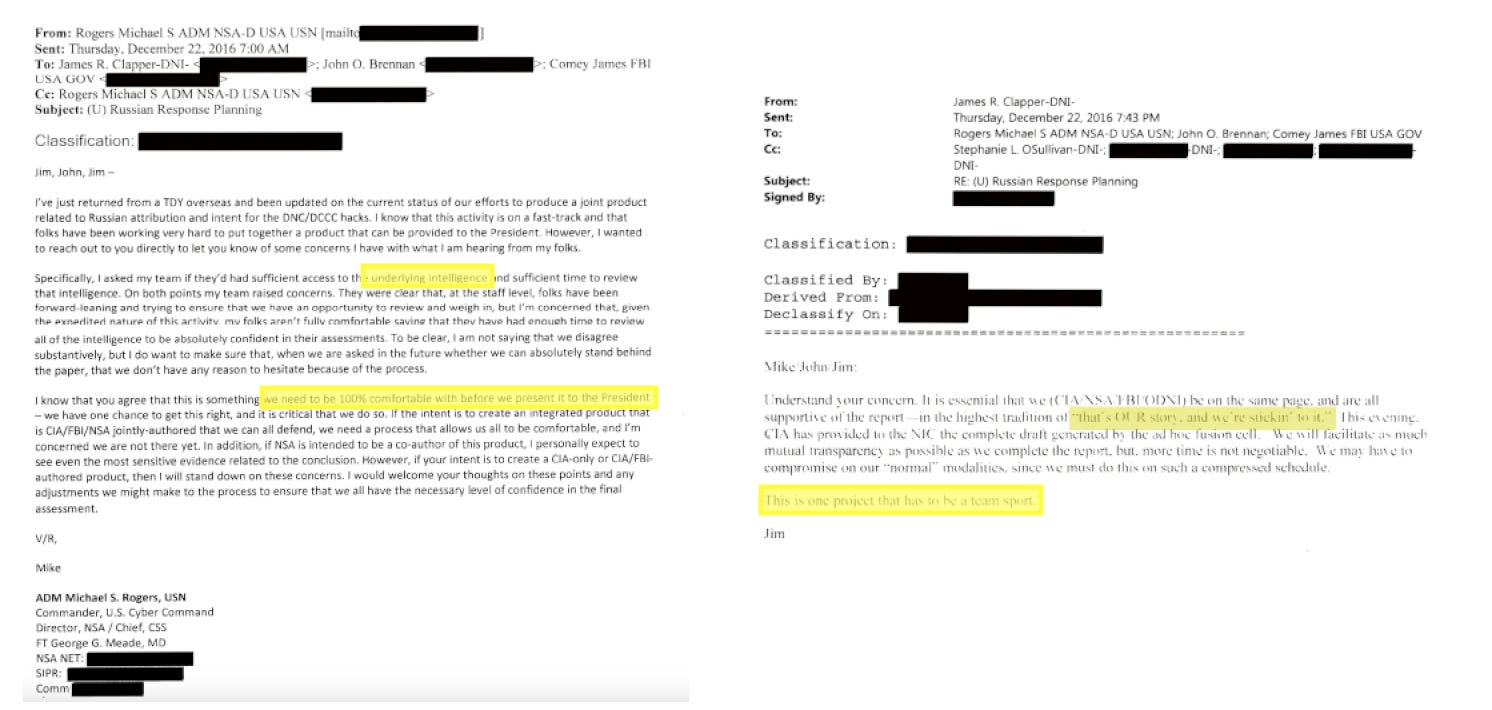
Specifically he referenced a pair of emails involving NSA chief Michael Rogers, who wasn’t sure he was “100% comfortable” with the use of “underlying material” like the Steele reports, and a reply from Clapper, Brennan, and Comey which told Rogers this was a “team sport” and he needed to sign off in the spirit of “that’s OUR story and we’re stickin’ to it”:
Brennan seethed and squirmed while the question was asked by Speciale — no outsider but like him, an intelligence professional — who had “access to the classified ICA.” When Speciale finished asking his question, Brennan blew up:
SPECIALE: There was, there was there was an email that went around from General Clapper, from General Clapper to yourself and… yourself and Comey, et cetera, that basically said, ‘We all gotta get on board with this, otherwise it isn’t gonna work,’ basically. I think that that email puts everybody in the crosshairs. I would like to hear what your justification was for supporting the dossier that was known to be false being used as source material in the second ICA…
BRENNAN: I don’t know who put you up to this.
SPECIALE: Nobody put me up to this, sir. I’m here on my own.
BRENNAN: I don’t know what role you played or who you are, but it’s a bunch of bullshit that you just passed on. (applause) It’s absolute…
SPECIALE: The emails are clear, sir.
BRENNAN: Bullshit.
SPECIALE: The emails are clear.
BRENNAN: Bullshit.
SPECIALE: The emails are clear.
MODERATOR: Next!
SPECIALE: Second question…
MODERATOR: Next, next, next next, next, next…
Speciale tried to shout out a second question about Brennan’s role in signing the “51 Spies” letter about the Hunter Biden laptop story. He was shouted down, but in another unplanned encounter, Speciale got to confront Brennan about the episode after the event.
“I didn’t expect him to come into the reception,” Speciale says. “I look over, and Brennan and Hayden are surrounded by a bunch of college students, and they’re talking, just an open conversation. So I go over and… I’m standing there. He sees me for a good full minute or two. He sees me and he’s kind of trying to get ready to leave anyway. And then I hit him with that question.”
Speciale asked about the implication that the laptop story was Russian disinformation. Brennan, furious, poked Speciale in the chest. “You misrepresented that,” he said, insisting he never called the story disinformation. This is kinda-sorta technically true — they did use the phrase “information operation” — but there can be no doubt about the intent behind the letter, which Politico published under the headline, “Hunter Biden Story is Russian Disinfo, Dozens of Former Intel Officials Say.” Either way, Brennan’s normal cocksure cold-blooded demeanor dissolved again:
This exchange flew around the Internet for good reason. “Wild. Guy’s not usually the poking type,” is how one Congressional source put it. Speciale was also no ordinary crowd member. His point of view is significant because he advised Gabbard and other administration officials not only about this case, but about structural failures within the Intelligence Community that led to Russiagate and other messes.
At what possible offenses are Trump Administration officials currently looking? Why was the “this is OUR story and we’re stickin’ to it” email printed above so important? I asked Speciale this morning about these and other questions:
I asked Speciale about the randomness of the event, particularly the second encounter in the reception area.
“The funny thing is, I didn’t even know the guy shooting the video,” he says. “I didn’t know anybody else in the room. It was a total stranger. And when I asked my question and [Brennan] poked me in the chest, I knew it got him on a personal level… And I turned and looked, and I saw the guy with the camera and I said, ‘Hey, man, can you send me that so I can post it? And he sent it to me.”
Speciale, who’s posted an extensive (and, for Russiagate obsessives like me, invaluable) timeline on his site, was at the Defense Intelligence Agency during the summer and fall of 2016, when the FBI and Brennan’s CIA were cooking up various schemes to infiltrate and surveil the Trump campaign. He says it’s not unusual that counterintelligence investigators might have looked at someone like Trump. “The guy’s probably a multi-billionaire. He has no political background, and he’s got hotels all over the world,” Speciale says. “These are the kinds of people that might be recruited by the Russians. It’s a possibility, at least.”
However, Speciale says, authorities can only investigate for a short time without predication. “The law is very specific,” he says. “You could only do that for 90 days without a predicate of some kind of foreign involvement.”
The FBI opened its “Crossfire Hurricane” investigation into Trump in July of 2016 on dubious grounds, citing an absurdly vague conversation between an Australian official named Alexander Downer and young Trump aide George Papadopoulous about “information” a mysterious not-even-Russian character named Josef Mifsud claimed Russians could deliver. The FBI quickly determined Papadopoulous was a dead end, because evidence “didn’t particularly indicate” he was in contact with Russians, and moved on to fellow aide Carter Page as a surveillance target. As has been determined by an Inspector General report and a criminal case, the FBI falsified its warrant application to use FISA spy authority on the campaign.
“That’s where the FBI really went off the rails,” Speciale says, “If they’d have just done the initial investigation and determined that he wasn’t a source for the Russians, they should have just closed ‘Crossfire Hurricane.’ It should have just been closed. But they didn’t. They kept it going, and they lied to the FISA court, and they did all these things.”
That might have gone unnoticed, if not for a historic curveball. “They didn’t expect Trump to win,” Speciale says. “Trump even admitted it on Joe Rogan, where he said, ‘I didn’t even know anybody in Washington.’ He didn’t expect to win either, Matt. He didn’t. He was shocked.”
The problem with that, Speciale says, was “they had run this illegal Crossfire Hurricane investigation, and [National Security Adviser Mike] Flynn would’ve discovered that. And Flynn would’ve immediately told Trump.”
This is the moment that has now been explained in the documents Gabbard and Patel released, but the public hasn’t really put it all together. On October 7, 2016, the first “Intelligence Community Assessment” came out, concluding the cyber penetration of the DNC was intended to “interfere with the U.S. election process.” That report, however, was narrowly focused on cyber issues.
The emails Gabbard released this summer show that the intelligence community as of December 8, 2016 was on the cusp of issuing a similar second report, saying, “Russian and criminal actors did not impact recent US election results by conducting malicious cyber activities against election infrastructure.” However, the White House instead hastily convened a meeting of its “Principals Committee,” after which a new, broader Assessment was assigned that would come to a much starker conclusion.
Gabbard’s office may have erred in giving the impression that the main issue was the contradiction between the later, Obama-ordered Intelligence Community Assessment of January 6th stating with “high confidence” Russia meddled in the 2016 election to elect Trump, and the “did not impact U.S. election results” report that was ready to be published on December 8th. What really happened was more complicated: the narrow cyber report was suddenly stopped, then swapped out for a much broader report. Why? Speciale, who said he was “involved” with helping set up the Principals Committee meeting, offers his thoughts.
“Here’s what I think happened,” he says. “The cyber ICA was the foundation document, and [intelligence officials] said, ‘Mr. President, the Russians did not hack the election…’ But Comey said, ‘But, Mr. President, they ran a disinformation campaign, and did all these other things.’ And Brennan’s on board with this. Obama says, ‘Well, where’s the reporting on that? And he said, ‘I want a fulsome, whole-of-government intelligence report on everything the Russians were doing, not just cyber…’ And so Obama directed them.”
He pauses, then goes on:
“Here’s the real rub,” he says. “I’ve been saying this for years and years and years and trying to get traction on it. If an intelligence officer from a foreign country comes to, say, the FBI, and gives them a suitcase of bogus intel, but it all looks legit, and he’s doing it at the behest of the foreign government, that’s considered espionage. That’s considered offensive counterintelligence, essentially giving an adversary fake secrets so that they use a lot of resources to either prove or disprove them, or they make decisions based on bad intel.”
A foreign agent giving bad intelligence, Speciale explains, is called OFCO, or Offensive Counterintelligence.
“The dossier came from [Christopher] Steele, a trained counterintelligence agent,” he says. “It gets funneled to the FBI. The FBI reads it. They’re like, ‘This kind of sounds a little fishy, but let’s look at it.’ As soon as they picked it up and kept running with it, because they knew it was bullshit, they knew what they were doing, they knew that they were doing an OFCO. And here’s why. Because we now look at the information. The investigations were being leaked to Congress, and then the congressmen and women were leaking it to the American people and saying, Hey, there’s an investigation into Donald Trump for Russian collusion.”
Speciale insists the operation “wasn’t against Trump, it was against everyone. It was against the entire American electorate.” The creation of the impression that the White House was compromised, the use of resources on bogus investigations, moving public opinion in a direction it largely holds to this day, was the intelligence community taking aim at the whole country. Trump was a major character, but not the whole story. As for the “team sport” emails Speciale pointed to, they’re evidence of collective guilty knowledge, for which there’s a legal term.
“It’s damning,” says Speciale. “At the very least, seditious conspiracy.”
Speciale, who’s ensconced in a lawsuit against Virginia gubernatorial candidate Abigail Spanberger (whom he claims issued a defamatory press release regarding his role in the J6 riots), had a lot more to say about Russiagate as well as the Hunter Biden story. The former DIA and DNI officer underscores, for instance, the bizarre fact that the ostensible key piece of evidence justifying the initial “Crossfire Hurricane” investigation of Trump, from the Maltese professor Josef Mifsud, is missing and somehow has never been found, nor has the person who planted two pipe bombs at J6.
“We can find a goatherd on the top of a mountain making IEDs in Afghanistan and hit him with a Predator missile,” he says. “But we can’t find a guy who dropped two fucking pipe bombs in plain sight in the middle of Washington, DC, our capital? And who in the fuck is Joseph Mifsud? We don’t even know. We don’t even know who that is. We don’t even know if that’s a real person.” He pauses.
“No way. No fucking way.”
I asked Speciale if, given his prior advisory role, he had any insight into what kind of conspiracy charge the administration is gunning for. Espionage? Sedition?
“I’ve had conversations, and I keep saying that I think this is just my suspicion,” he says. “My hope is that they want to have all their Ts crossed and their Is dotted before they level any public accusations of seditious conspiracy. I don’t think they’re going to go for treason. I think they’re going to go for seditious conspiracy, but I hope [Trump] puts the right person on messaging for this. Because from the White House side, not just from the DOJ, but from the White House side, their messaging has to be really, really carefully done to say, listen, ‘We don’t want revenge. We don’t want retribution. We want a restoration of the rule of law.’”
Jim Jordan’s Judiciary Committee referred Brennan for prosecution two weeks ago. We’ll see what happens, but there’s no question that tensions are high, as last week’s encounter shows.
Speciale delivery. Brennan is a ghoul who deserves prosecution. Please don’t let the AWFL CIA Karen win Virginia tomorrow.
Brennan reveals once again the arrogance of the DC ruling class. He is the Katie Porter of the intelligence community with a little bit of Greta "How Dare You" psychosis built in. He thinks if he says it is BS, it is our job to believe him. I could never go to such an event, I fear I would have punched Brennan on the second BS. He and his cohorts are despicable. I pray Tulsi, Patel, and crew get some form of justice for the American people.