

“You’re only going to create a real problem for an FBI employee if you call ‘em direct this way.”
Senior FBI official Thomas Gregory Motta was upset that I dared to call him to talk about the bureau’s hidden experiments on humans.
He joined the bureau in 1998 and was promoted to the FBI’s senior ranks nearly 20 years ago. During his tenure, the bureau has grown proficient at snooping on journalists — as documented in a secret government report published by Racket — without having to face their questions.
Motta is a decorated FBI veteran, credited with an intelligence community award in 2007 for modernizing the American government’s most important foreign espionage tool and having worked on the secretive “going dark” national surveillance program.
After internal criticism surfaced more than a decade ago involving the bureau’s experiments on humans, the FBI put Motta in charge of an internal team revamping its approach to human subjects research.
In 2023, Motta delivered a presentation detailing the government’s work on secret human experiments, going all the way back to a catastrophic project that saw a CIA scientist drugged with LSD plunging to his death from a hotel room window 70 years earlier.
The government labeled his presentation, “NOT AUTHORIZED FOR POSTING ON THE INTERNET.” Here is Motta’s presentation to the Public Responsibility in Medicine and Research conference, posted on Racket in full, with only Motta’s personal information removed:

Among the types of human experiments undertaken by the FBI, as detailed by Motta, are research involving facial recognition studies and algorithm testing, genetics, violent extremism, interrogation science, and more.
What is the bureau’s “oldest, continuous human subject research project?” It involves killers, namely the “Serial Homicide Interviews of Incarcerated Offenders” that Motta captioned with a photo of celebrated fictional monster Hannibal Lecter, as played by Anthony Hopkins in Silence of the Lambs.
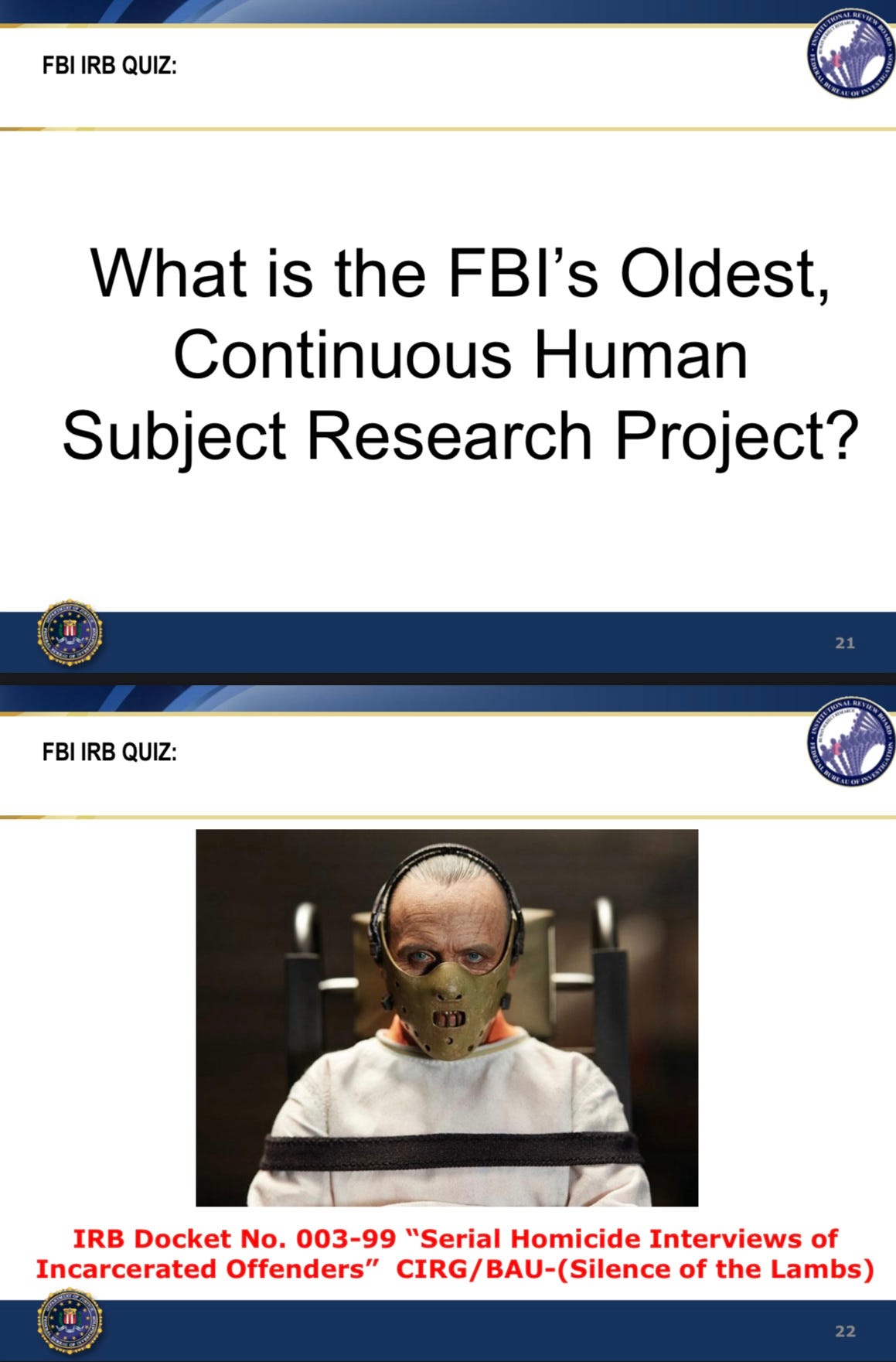
The psychological thriller depicts a young FBI trainee, actress Jodie Foster as Clarice Starling, trying to get inside the head of the cannibalistic killer, Hopkins’ Dr. Hannibal Lecter.
Motta led the Institutional Review Board for Human Subject Research Protection to oversee such studies at the FBI. In 2023, the secretive unit was moved under the auspices of the “Next Generation Technology Lawful Access Section.”
Motta told me he is no longer the chairman of the board, “not even at liberty to give the name of the chair” overseeing research now, and he said he “probably wouldn’t” speak to me if I approached him formally through the bureau’s press office.
He did not speak with me again and the FBI declined to answer all questions about the bureau’s human experiments. It also rejected Racket’s formal requests to interview those involved with experiments upon Americans.
We found some of the Americans the FBI is studying anyway: identical twins.
The FBI’s decades-long experiments on twins dwarf the scope of deadly Nazi studies
Throughout human history, twins have been the subject of intense interest for outlandish experiments on humans.
The German Nazis’ deadly human experiments researching genetics ensnared approximately 3,000 twins, 1,500 pairs of people, during the 1940s, according to the Children of Auschwitz Nazi Deadly Lab Experiments Survivors.
Fewer than 200 children are estimated to have survived, according to an investigation into the twins of Auschwitz authored in 1992.
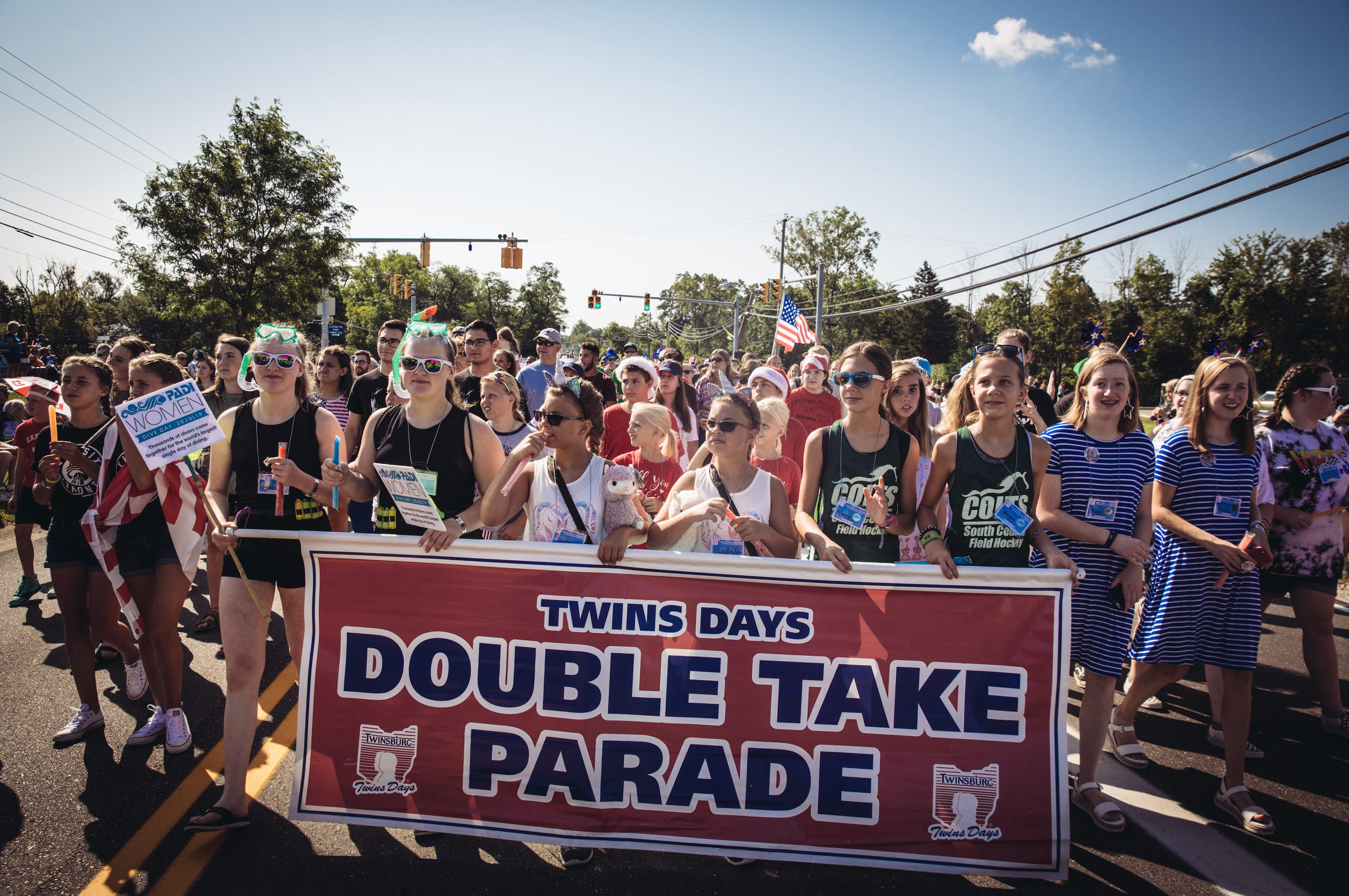
In America, a major gathering of twins occurs every year, and the FBI looks to take advantage of the large pool of potential test subjects who consent to its experiments.
The Twins Day Festival in Twinsburg, Ohio, annually attracts nearly 2,500 sets of twins, or close to 5,000 people, according to the FBI’s Criminal Justice Information Services Division 2025 Year in Review.
The FBI’s review said it has sponsored the West Virginia University Twins Day Biometric Collection since 2010, involving those twins who voluntarily participate.
“This collaboration has resulted in the CJIS Division housing a vast dataset of twins’ biometrics with the only known twin age-progression dataset,” the review said. “The FBI uses the dataset to test its own capabilities to accurately identify individuals.”
One twin who grew suspicious of the FBI’s experiments at the Twins Day Festival’s 50th annual gathering in 2025 posted a video to TikTok showing some of the experiments underway.
The festival’s nondescript research sign did not carry the FBI’s insignia but it was adorned with bright red flags:
JoJo Gentry, a twin who has attended the festival for more than 20 years and participated in its human experimentation, told Racket she understood West Virginia University was conducting research with the FBI and signed consent forms.
But Gentry, a former sports anchor who now oversees a multimedia production company, said she is not so sure other twins read the fine print.
She said the research participants are typically hanging out while standing in line, enjoying the rare opportunity to meet other identical twins from near and far.
“You’re standing outside, it’s a hot summer day and you typically have ice cream while you’re waiting so usually your attention is just drawn to whoever is around you and having a conversation before you greet the people, whoever are at the front of the survey area,” Gentry said. “And they say, ‘Hi,’ and it’s brief, and say, ‘Sign this paperwork,’ and you sign it and you go in [and] say, ‘Here’s your 50 bucks,’ and you leave.”
Gentry said she and her sister gave saliva samples when they were younger.
“We thought extra money was cool and with an accreditation, with a higher education university and some corporations that were present. We felt like whatever they were offering was legitimate,” Gentry said. “And, of course, they had friendly faces there.”
Gentry said she has found the data collection process transparent, though she has some lingering questions.
“I’ve learned a little bit about what the government does and how it processes information so I’m like, ‘Oh, who has my saliva from 10 years ago?” Gentry said.
It’s an important question and a difficult one to answer. Data collected at Twins Day is “beneficial to other government agencies, trusted partners, and academic institutions,” according to the FBI’s CJIS 2025 Year in Review.
The identities of the other agencies and trusted partners are not clear. In March, FBI Director Kash Patel said on X the bureau, “expanded biometric collection overseas with foreign partners” to thwart bad guys, also without revealing the partners working with the U.S. government.
Biometric data from identical twins collected by the FBI goes into the CJIS’ Data Analysis Support Laboratory, according to a 2024 Privacy Impact Assessment.
“The multi-year dataset of identical twins’ biometrics in DASL enables the FBI to conduct various biometric algorithm evaluations,” the privacy assessment said. “Tests conducted using this data confirmed that fingerprints and iris biometrics are truly unique.”
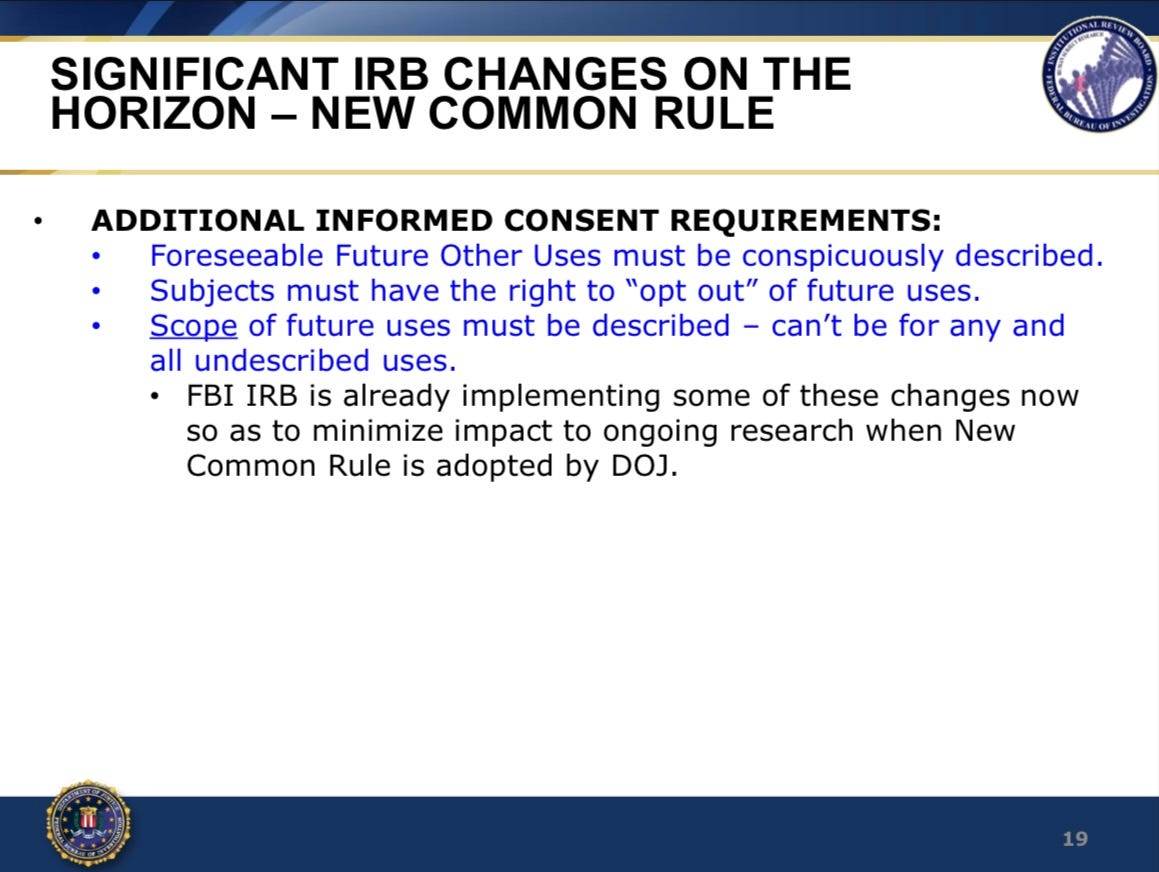
Humans knowingly experimented upon by the FBI may expect more fulsome information about how the FBI is using their biometric data. Motta’s 2023 presentation said human subjects must have the right to opt out of future uses of their data and the scope of the future uses must be described to the test subjects.
The FBI’s 2024 privacy assessment said the biometric data and personally identifiable information gathered in its lab will not be shared externally, “except when the FBI shares sanitized—that is, pseudonymized—biometric data from the [Next Generation Identification] System with the National Institute of Standards and Technology.”
Sanitized, pseudonymized, and anonymous no longer mean hidden, however.
Motta’s 2023 presentation said biometrics such as fingerprints, facial images, and DNA are not truly anonymizable, and artificial intelligence is complicating things further.
“AI is challenging the assumptions of anonymity in big data sets,” Motta’s presentation said.
The FBI’s security is also far from best-in-class. U.S. investigators reportedly suspect China of breaching an FBI computer network holding domestic surveillance orders, while Iran-linked hackers appear to be behind a breach of FBI Director Kash Patel’s personal emails that spilled online in March.
The FBI’s human experiments present a risky proposition for both the test subjects and those working in labs.
Motta’s 2023 presentation included a warning that said those who fail to get prior approval from his board before conducting such human research may be stuck with the blame and the financial burden if things go haywire.
“You could, in theory, be on your own if non-IRB-reviewed research creates financial liability,” Motta’s presentation said.
The emergence of data about the FBI’s human experimentation is just the latest in a series of leaks and revelations describing secret programs run by the FBI and other agencies that seem far from normal enforcement. From off-books “prohibited access” investigations to political surveillance to the buying of personal data like geolocation, Americans are increasingly subject to the same bizarre tactics intelligence agencies have deployed abroad or contracted out to other countries. What else is being hidden?
I am sorry but this article was a ton of garbage. There is nothing close to Nazi style " experimentation" mentioned in this study. Like his last article, Lovelace is like a 2 with Matt being a 10
Reviewing the FBI presentation, slide by slide, seeing the details of all the various government departments and policies, once again served as a reminder of the BLOAT of our government and how off message every single department has become.