

In Moscow in July 1997, reporter Leonid Krutakov had a scoop. Anatoly Chubais, the Harvard-educated privatization boss and right hand of Boris Yeltsin, had been given a $3 million loan from Stolichny Bank just before that same bank — controlled by an intimidating “businessman” named Alexander Smolensky — won an auction for a state-owned agricultural property, Agroprombank.
It was a great story, but Krutakov had to make an epic journey to print it. First fired from Chubais-friendly Komsomolskaya Pravda, he was rejected by Moskovsky Komsomolets, then appealed to the legendary editor of Top Secret, Artem Borovik, before that magazine, too, turned him down. Finally Krutakov struck a deal to publish a piece called “Credit… Or Lose” — a play on the USAID-inspired “Vote or Lose” commercials crucial to Yeltsin’s recent re-election — in Izvestia. Immediately after, Izvestia editor Igor Golombiyevsky was fired, and in a town full of hotshot muckrakers, Krutakov was feted for turning four newsrooms upside down in pursuit of a single political bribery story.
I was eventually fortunate to get a chance to work under Leonid at his paper Stringer, and watched in admiration as he and a handful of colleagues took big risks at a time when Russian reporters were routinely shot, beaten, blown up, stuffed in drainpipes, or worse. Decades later, the writer I remembered for short-form breaking news has published a massive, meticulously researched history of the oil business called “Oil and Peace,” analogous in scope to books like Daniel Yergin’s The Prize. The book argues human history has become intertwined with oil to the point where there’s virtually no line between petroleum and politics itself, while underscoring the lunatic inefficiency of the oil-dominated world.
American analyses of these questions tend to focus obsessively on global warming, but Krutakov’s book spends more time focusing on the doomed math of tying so much of our lives — everything from light to food to antihistamines to dentures to transportation — to the production of one hydrocarbon. The high-energy lifestyles enjoyed by residents of the West are dependent on low extraction costs in developing nations, and the political unsustainability calculus is more troubling than the ecological one:
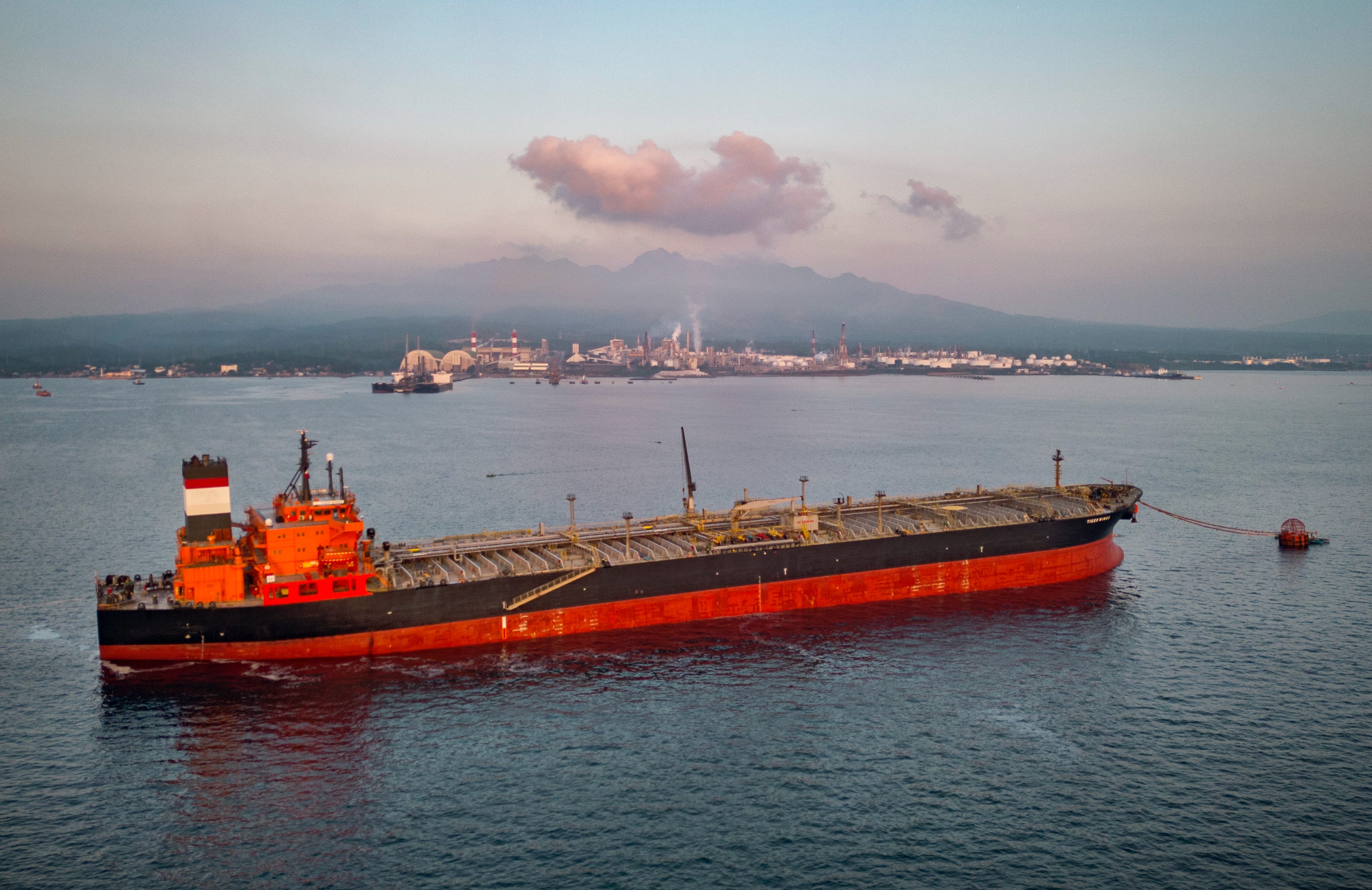
The energy density of oil is incredible… 159 liters of oil is equivalent to about 100 liters of gasoline. A month of driving equals a thousand kilometers, with an average consumption of 10 liters per kilometer. This means that the average driver burns as much energy in a month as it would take 12 people to build a three-story mansion in a year… It’s hard to even imagine how many people would have to work, and for how long, to provide the energy equivalent of one voyage of a supertanker from the Persian Gulf to Rotterdam.
Krutakov started working on this book, his first, two decades ago. Having never visited the U.S., he nonetheless spends a significant portion of the book tracing the rise of John D. Rockefeller, who’s described in enormous detail as a brilliant, morally dubious visionary. “Rockefeller built the world in which we live,” Krutakov says. “He laid the foundations of the oil industry as vertically integrated with an internal pricing system that allows controlling the cost of the final product.”
There are parts of the book that will cause an American reader to raise an eyebrow, like the assertion that the American Civil War “wasn’t fought over human rights or a struggle over slavery” but over two warring models of economics, between muscle and machine, “biological” and “mineral” energy. The bulk of America’s oil-producing regions were located in the South, which presented a considerable problem for the Union, which was heavily invested in the nascent new business empire led by Rockefeller.
It’s not news that a long list of subsequent wars were fought with control over the oil supply as either a central motivation or a significant subtext, with Hitler’s invasion of Russia in search of the Caspian petroleum fields a classic example. Krutakov he writes in detail about this key role oil played in triggering two world wars and misadventures in Iraq, Syria, Libya, and elsewhere. Still, the subject has never been more relevant than now. I asked him about oil’s role in the Iran war and what the future of a world rapidly burning through its energy reserves looks like:
MT: You say you’ve been working on this book for twenty years. What prompted you to start on this subject?
Leonid Krutakov: The topic seized me right after September 11, 2001. Then I realized that the world had entered a new phase of development, where energy resources became key to solving economic questions. The collapse of Enron, as the most “advanced” energy company in the world, showed that the ratio of real flows of physical oil to futures volumes of “paper oil” didn’t stand up to risk-hedging market tools. The market had been pushed too far into the future. The lever of financial engineering had exceeded the horizon of risk insurance. Regulatory political factors came to the forefront. It became clear that the energy component would lead the world to a global clash over energy sources, which we are witnessing today: Iraq, Libya, Syria, Ukraine, Russia, Iran…
MT: You write that the world cannot exist without oil. Will that always be the case? Is there an analog in history to our current oil dependence?
Leonid Krutakov: The world can exist without oil, but not in the same quantity and not in the same configuration as today. Oil is an accumulation of biological energy, concentrating enormous volumes of solar energy dispersed over time and space. One gallon of the gasoline we use today contains 90 metric tons of ancient plant substances. In one year, humanity burns a volume of fossil fuel equivalent to all the animal and plant life that inhabited the Earth over 400 years. We are eating through the lives and well-being of future generations.
Oil, of course, is not the only energy source. Today it is actively being replaced by LNG and coal, but these are also finite natural resources. Moreover, today’s agriculture is built on petrochemistry. Without nitrates and “targeted” pesticides, industrialized farms cannot exist, just as huge cattle farms cannot. As the Iran crisis shows, a shortage of oil and gas immediately drives up fertilizer prices, which means developing countries with growing populations will not be able to feed themselves.
So the world can exist without oil only in a limited format, which would lead to a decline in medical care and life expectancy (even ordinary aspirin is a petrochemical product). A drop in yields would lead to more hunger and epidemics in poorly developed countries. We would see a world of shrinking possibilities.
As for an analog to today’s dependence on oil, such dependence has always existed. Even in the era of Standard Oil, about 400 different products were produced from oil. Today this assortment has grown by orders of magnitude, including diapers and baby bottles. So the dependence has been growing all this time. And whenever energy-deficient countries faced questions of shortage, a global crisis followed. The analog of today is the 1973 crisis.
MT: Prior to the beginning of the war in Ukraine, Europe was largely dependent on Russian oil, as you wrote. Now the United States is in a war led by a president who wants to “take oil” from Iran. Are all wars now about energy (and oil in particular)?
Leonid Krutakov: It has always been so, for at least the last 150 years, since oil became the first (if you don’t count gold and silver) global commodity requiring unification of trading rules on a world scale. Oil became the first global commodity traded in only one currency. Oil lies at the core of the rules of the global market.
I show that the First and Second World Wars (Churchill regarded them as a single 30-year war) were also about energy resources, about the right to establish norms, standards, and regulations for the global market. The oil underpinning (more precisely, the kerosene underpinning) even ties to the Civil War of the North and South, the “oil triangle” war among three Eastern Seaboard states and agricultural states of America.
Iran, as I noted above, is only one link in the new Great War for the planet’s global market. The Libyan story began with a project to construct an oil pipeline to Italy along the bottom of the Mediterranean Sea, which would make Europe, together with Russian pipelines, energy-independent from sea deliveries of oil and gas. Syria should have become part of the oil pipeline from Iran through Iraq, along the bottom of the Mediterranean to Europe. Literally on the eve of Syrian events, a tripartite memorandum Iran-Iraq-Syria was signed about the pipeline. Ukraine, before Maidan and the start of the Special Military Operation, was the main oil-and-gas hub between Europe and Russia.
In the same line is the explosion of the gas “Nord Stream” pipelines, which established a direct link between Germany and Russia, bypassing Ukraine. One can recall Biden’s statement on the eve of the explosion that the U.S. would stop gas deliveries via Nord Stream. When asked how, he said he couldn’t say at that moment. As for Venezuela, perhaps no need to remind—everything happened right before our eyes. So Iran is not a precedent.
MT: Thirty years ago American and European oil titans dominated the market and Western advisers considered Russia a minor power, unable to realize the potential of its natural resources. Have the roles changed at all?
Leonid Krutakov: Russia remains fundamentally a rentier country. Over the past 30 years Russia has failed to convert its energy opportunities into cognitive capital. We did not convert oil revenues into education and science, we did not recreate an autonomous technological and industrial contour, as Rockefeller and America managed to do from scratch. Russia remains a critically important factor on the global energy map. Its military potential is significant, the foundations of which were laid under the USSR. In this sense, Russia remains a politically significant subject of world relations, but there hasn’t yet been a fundamental reorientation of the country’s development strategy at a deep level. I say this with pain for my homeland, because genuine supremacy is formed not in raw materials or the military sphere, but in education. Knowledge and science make a country truly great and significant for the whole of world civilization.
MT: You write about the “red line” around the Arabian Peninsula. There a hot war has erupted. What do you think are its causes?
Leonid Krutakov: Since the discovery of the first oil on the Arabian Peninsula, the U.S. has made the kingdom its oil dominion. After World War II, when Churchill tried to strike a deal with Roosevelt to divide the Middle East resource base between the two nations, the U.S. president answered him unequivocally that “the oil of Saudi Arabia belongs to America.” In the second book, which is being prepared for publication now, I explain this in more detail, with references to primary sources. The strikes on Saudi Arabia, the Emirates, Bahrain, and Qatar by Iran mean that Tehran understands very well what bets are being placed in today’s game. It understands where the Western world’s most vulnerable spot lies. It understands why Trump came with the war against Iran.
MT: You write that you hope to avoid a conventional history, and instead create a book that captures the “underground currents” of this time period, as might be visible to future generations. What prompted that approach?
Leonid Krutakov: There has been a lot of research written about oil. I was seeking a new approach, aiming to rise above market conjuncture. To assess oil not just as an energy resource, but as a foundation for the entire social order and the system of international relations. I set the task of explaining historical patterns not through the will and personal characteristics of political leaders (such as Trump, for example, or Putin), but through the material resources that allow history itself to materialize. To turn the future from unpredictable into predictable. To find a basis for a global agreement among key world players.
I believed that if you expose the real global problem and publicize it, the question of future world parity could be solved not on the basis of power resources, but on a rational approach to our possibilities and the resources of planet Earth.
MT: Switching topics: what don’t Americans understand about the war in Ukraine? What was your reaction when the West cut off access to Russian television and tried to arrest people like Dmitry Simes? In the 2000s you had a reputation as a fearless reporter — what memories do you have of those times?
Leonid Krutakov: I think the American government understands the reasons for the war in Ukraine very well. The fact that these reasons are unclear to the American people only shows that these reasons have not been made public, as in the cases of Venezuela and Iran. For Russia, the situation of Ukraine potentially joining NATO was an existential threat. It’s somewhat like placing Chinese or Russian military contingents in Mexico or Venezuela.
Everyone remembers how the Cuban Missile Crisis began, almost leading the world to nuclear war: the deployment of American medium-range missiles capable of carrying nuclear warheads in Turkey. The USSR, in response, began placing its missiles in Cuba. In this sense, the Ukrainian situation is a replica of the Cuban Missile Crisis. Thank God, so far there has been no direct confrontation between the United States and Russia.
As for cutting off access to Russian television, I can only say that this is how it always happens when you lose in direct information confrontation. When your arguments yield to your opponent’s arguments. This happened in the Soviet Union. And, unfortunately, today in Russia with cutting off access to Telegram. You cannot retreat into your own shell. In a war of meanings, victory can be achieved only through meaning, content, arguments, ideas. Retreat from discussion does not mean victory; it means admission of defeat.
The attempt to arrest Dmitry Simes, like the killings of journalists, is a symptom of a deeper disease affecting the whole world discourse. The revolver has always been and remains the last argument in a debate when you have nothing left to respond with. Look at the film industry. Where is “Rain Man”? Where is “One Flew Over the Cuckoo’s Nest”? Only lines and comics. We in the cultural sphere have similar trends…
I haven’t felt like a journalist for a long time. It all ended with the death of the Stringer, in the issue you also participated in. The last issue was, ironically, the one devoted to the events of September 11, 2001. How do I see that time? A time of global catastrophes and enormous possibilities. A time of adventurers and unscrupulous brokers. A huge country dying in bloody convulsions, while someone was making enormous fortunes from it. In the second book (a continuation of the first), I want to devote attention to this period—the period of the Great Privatization or the selling-off of the country at retail.
MT: Thanks, Leonid, and good luck.

"The bulk of America’s oil-producing regions were located in the South, which presented a considerable problem for the Union, which was heavily invested in the nascent new business empire led by Rockefeller."
Huh? At the time of the Civil War Western Pennsylvania was the only significant oil-producing region in the US. And even that only started in 1859. Sloppy language at best!
Civil war started in 1861. Standard oil’s precursor started in 1863. Kerosene was introduce in the 1860s. When you get small obvious facts wrong it call into question entire narratives