


Racket readers may have noticed it’s quiet in here. There are three reasons, two temporary. I’ve been working on a book for two years and am in a home stretch. The second involves a breaking-type story that is a document-heavy slog, but coming.
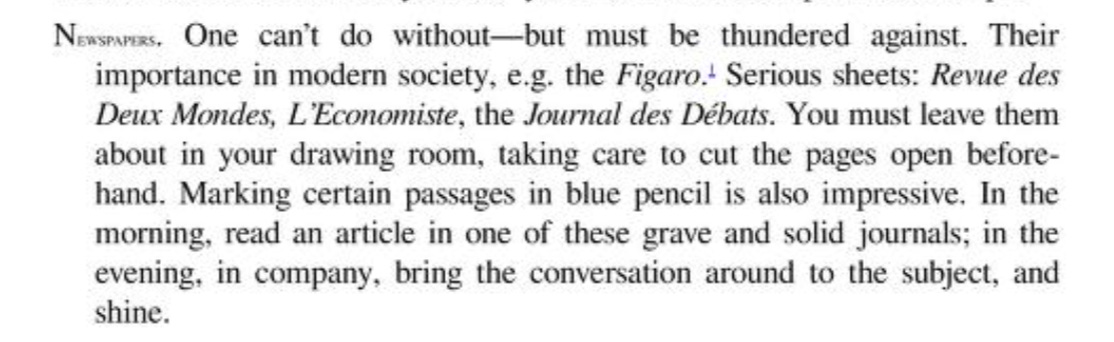
The third is more complicated. Call it an existential pileup. When I entered journalism I filed as unimportant the fact that many of my heroes left warnings to avoid the profession. The most famous are known, like Hunter Thompson calling his profession a place where “thieves and pimps run free and good men die like dogs,” or Oscar Wilde saying, “journalism is unreadable, and literature is not read.” Balzac said journalism was a “bottomless pit of iniquity and treachery and lies,” while Flaubert, whose Dictionary of Received Ideas was one of a handful of books I lugged around the world throughout my twenties, wrote in a letter to George Sand that the press is a “school of demoralization” that “dispenses with thinking.” H.L. Mencken, whom I idolized, said the newspaper was a “public organ for making the ignorant more ignorant and the crazy crazier.”
I laughed all this off once, and ignored a professor (one who’d been good to me and deserved my attention) who implored me to listen. Journalism is an easy target. Many of its harshest critics were cheerful practitioners, and even the most savage satires, like Evelyn Waugh’s Scoop, were lovingly rendered. The best American writers revered the job, Mencken being the most obvious example. He talked of living the “life of kings,” even as he denounced newspapers as factories for mass-producing the opinions of Babbitts, jobholders, and other assorted Boobi Americani. When Thompson teed off on journalism, it was usually in the same breath as an admission there was no other life that allowed a person, in a snap, to go from being broke to abusing drugs in the Nevada desert on a stranger’s tab.
Now, I wonder.
A writer’s most unforgivable sin is being boring, which makes saying anything in this time period tough. Whether you’re reporting or commenting, the game is up once audiences are able to classify according to current political taxonomy. You can publish 50 words or 5000, but what you’re producing for most audiences is a compass heading, showing where you reside on a map in relation to Donald Trump. Maybe you wanted to say something else, but the compass reading is the only thing most people care about, so that’s how the thing will be compressed, summarized, and circulated.
It’s fine if you find talking about Donald Trump interesting, or if it’s important to you that neighbors and family receive an unambiguous signal about where you’d like to place yourself on the TrumpScape. You can put out a strong “against” signal in legacy media – that’s allowed – while almost any other strong statement is interpreted in the other direction.
For instance, we’ll soon come up on the ten-year anniversary of Peter Beinart’s 2017 “The Anti-anti Trump Right” column in The Atlantic, which defined most anything that isn’t explicit opposition to Trump as “evading the reality” and “opposing the people who oppose Trump.” Under that logic, just about anything could be dismissed as throat-clearing on the way to a refusal to Say The Required Things, about Trump. This half-clever formulation arrived in sync with a large chunk of American academia electing to purge the social sciences of “objective” pursuit of knowledge, or what one Literature professor derided as the act of “intentionally [dissociating] their work from the political and ideological exigencies of the time.”
If the challenge is to allow people to have identities independent of this scheme, then the task becomes creating work that resists taxonomy. If neither Norm Eisen nor Stephen Miller can classify a thing, and people still enjoy reading it, you’re on to something. The original thinking behind discussions about old books with Walter Kirn was to remind myself (and, hopefully, others) that we once read all sorts of things that were smart, funny, and provocative that had little to do with politics. Some things are timeless, which is why we loved them. In his recent essay, “Advocacy in Literary Studies,” Northwestern Professor Gary Saul Morson wrote:
As William Hazlitt pointed out in his essay “Why the Arts Are Not Progressive?” literature, unlike the hard sciences, does not progress. Aristotle’s Poetics is still relevant in a way that his physics is not. Any first-year physics student knows more physics than Aristotle, but no dramatist has surpassed Shakespeare. Novelists of the present have not created works as significant as War and Peace and Anna Karenina.
The good professor’s essay was part of a “State of Scholarship” report formulated and promoted by the chancellors of Vanderbilt University and Washington University of St. Louis. Naturally, that report has already been denounced as a “diabolical” attack on academics who are “critical of configurations of power in the Trump years.” Call it anti-anti-Trump academia; even the simple observation that Anna Karenina will probably always be a great book offends someone’s current politics.
This is not to say that journalism is dead or that there isn’t a point to doing interviews and leaving a record of what this weird and unhappy time was about. However, I’m beginning to appreciate those old warnings.
You know you’re operating in a dysfunctional landscape when the most influential stories of a period are set in the distant past (Julius Caesar, The Crucible) or in a fantastical other-world (Gulliver’s Travels, Minority Report). Take The Master and Margarita. Mikhail Bulgakov knew by the mid-1930s he’d never see his characters in print, not in Stalin’s world. He wrote partly for a hypothetical future, and partly for his sanity. In a severe totalitarian landscape, he created a story about mortality, art, love, bravery, and other timeless questions, laughing all the way. People reading that book 50 years from now won’t have a clue he wrote it in the middle of the purges, which seems like the ultimate triumph over those purges.
Of course, that’s different. I bring it up only to ask for patience as I try to find new ways to do more prosaic traditional reporting or research on this site without being dull. I have ideas, including a project where I’m looking for academic escapees who might be interested in helping dig for a thing or two. Until then, please hang in, and don’t be shy about offering suggestions. If you want me to visit an event, I’m now more able to do that. I just don’t want to play the binary game. The whole country can’t be the same desert. Can’t we find new worlds to explore?
I feel that. I wish - in a perfect world - we weren't facing down an intolerant Left that guards culture like the ghost in Poltergeist. If they just let down the high wall, we could all talk like regular people again. Because man, do we all need shared culture...
This is pure Matt Taibbi and I love it. Take all the time you need, Matt, I’ll be waiting.