


“Where can a fellow shit in private? Where indeed?” — Aristophanes, The Assemblywomen
After a long search I’m teaming up with fellow Substacker Brad Pearce to launch Get Lit, a show that hopes to scratch the same itch as the book segments from America This Week, except books will be the whole program. We’re going to jump from old to new, from short to long, from his favorites (Brad is significantly better-read than me) to mine. The aim is a zany one; see below. The format hopes to bring the audience in on the discussion, so the first show each week will be live, starting at 4:30 PM ET.

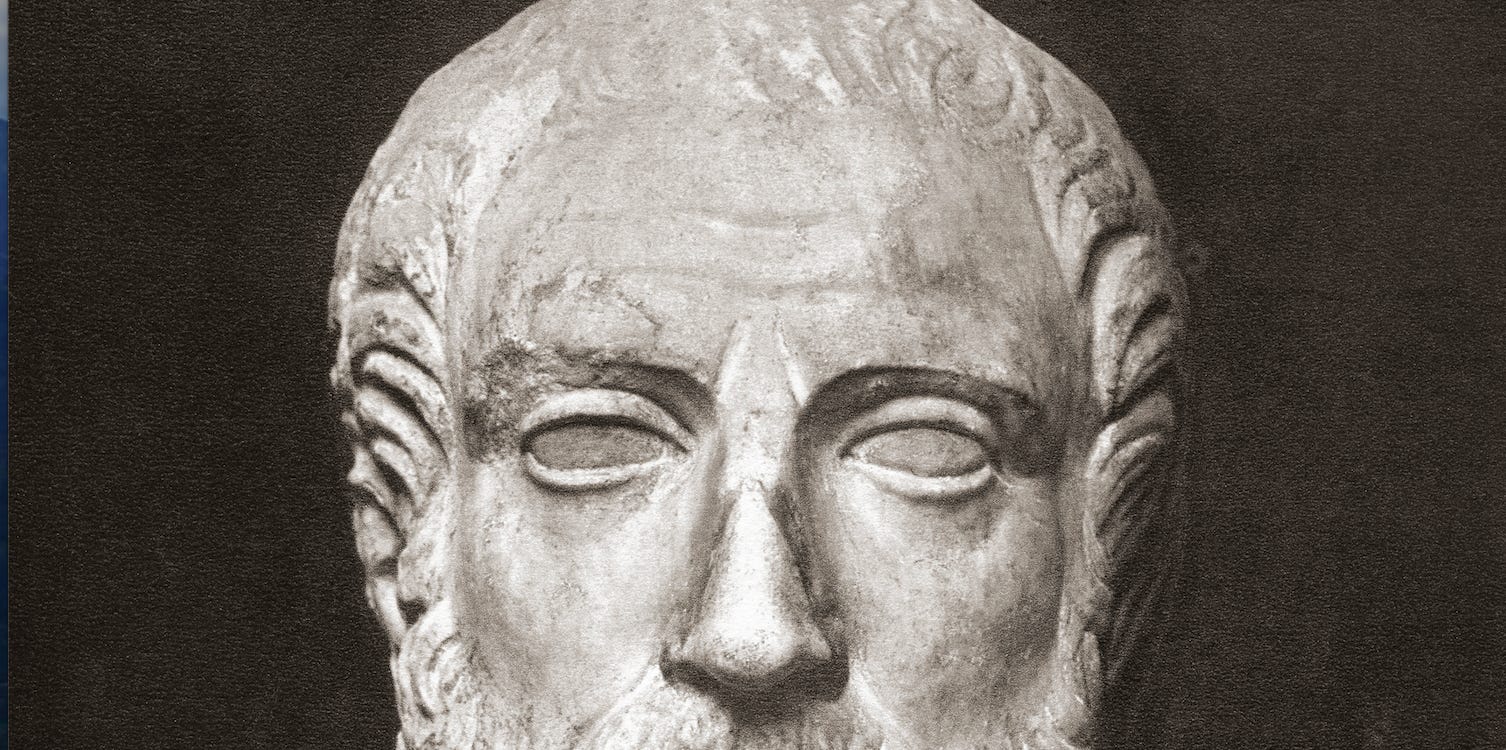
The book for Monday is short and riotously funny: The Assemblywomen by Aristophanes. It’s a play about an uprising in which women of Athens disguise themselves as men, overthrow the state, abolish private property, and impose sexual communism. What’s that? We’ll get into that, and more.
You’ll be able to find the live show Monday on Substack, YouTube, and Rumble (we’ll follow up with the links day-of). You’ll also be able to tune in at either of our X accounts, @mtaibbi or @waywardrabbler. There will be a second taped show each week.
Normally, we’ll announce far in advance what we’re reading (Dostoyevsky lurks in the near future). Two reasons we’re behaving differently with The Assemblywomen: a) it’s just a 30-45-minute read, and b) we’re anxious to get started.
Brad is also a father, but 17 years younger than me and one of the most interesting people I’ve talked to in ages. I suspect some Racket readers will have a hard time believing how much stuff is in this guy’s head, and how quickly he’s able to retrieve it. He has his own reasons for doing the show and may eventually want to articulate them at his site The Wayward Rabbler. I did want to explain a little about the idea behind Get Lit and my reasons for wanting to do it, apart from the obvious, namely that I miss the book discussions with Walter Kirn.
Sometime in the last decade or so I started to feel a nagging fear that most of what I learned in school was either outright nonsense or guesswork, and that by repeating it I’d contributed mightily to the dumbing down of America. The fear was not about errors like WMD or Russigate, about which I’d been careful, but a generalized air of ironic dickishness about the past, about which I hadn’t. I went along with snickering about people from previous centuries who were consumed by religious superstitions or traded pistol-shot over insults or still hadn’t conquered longitude or antibiotics or owned slaves or sent people to prisons for being gay. I completely bought the idea that while individual exemplars of Homo Americanus modernus might be a bit dense, as a whole we had the big questions figured out, and just struggled to figure out high-class problems like overproduction of food and clothes.
Now I’m almost certain this country is run by people who don’t know anything about anything, and that I need to spend my remaining time on earth getting the real education I missed the first time. Take Classics, funding for study of which has been cut significantly all over the country. In the period between 2016-2020 when there was a special mania for wiping out these books, the overwhelming consensus both on campuses and in media treatments was that these “Eurocentric” texts lacked “relevance” to modernity, and particularly lacked focus on the really important stuff, as The Guardian put it after Yale students voted to “decolonize” the canon in 2016:
They want the university to abolish the major English poets requirement, and to refocus the course’s pre-1800/1900 requirements “to deliberately include literatures relating to gender, race, sexuality, ableism, and ethnicity… A year spent around a seminar table where the literary contributions of women, people of colour, and queer folk are absent actively harms all students, regardless of their identity,” and that the course “creates a culture that is especially hostile to students of colour.”
People who wrote these petitions and these articles never read these books, or not all of them, anyway. We chose The Assemblywomen by Aristophanes for a reason. Not only is it a short, wildly entertaining text, but within about ten minutes of reading you’ll realize almost everything you’ve been told about the study of “antiquity” is a lie. People thousands of years ago were making the same jokes the best and raunchiest sketch comedians of our era might have, if they were allowed. These aren’t old, dead texts, they’re survived by being vibrant and always-relevant, which also means highly predictive. They’re kept out of public view more and more now for a variety of reasons, one of which has to be that it’s clear proof that people back then weren’t uninformed lesser mammals but just like us, only maybe a bit more intellectually confident and freer to laugh.
Brad will lead the way with a lot of the books we’re going to cover, new and old, but we structured things in a way that will allow us to teach each other as we go, and maybe also solicit advice from a handful of people who really know and love the books we choose. It might be Aristophanes today, Dashiell Hammett tomorrow, then Dostoyevsky, then who knows? But it won’t be boring, and it won’t be a fight about the Internet stupidities of the day. I can’t wait, and hope you’ll join us Monday.
As I should introduce myself to future listeners, I would say that it is remarkable the extent to which Matt describes an intellectual journey quite similar to how I described my own starting my substack 4 years ago, though I don't believe he read this.
Really looking forward to doing this!
[I feel compelled to add, I was out of practice at writing when I wrote this, and also of course life takes you unexpected directions, I began to write quite different things than I expected, largely very long pieces about the history and current events of various countries.]
https://www.thewaywardrabbler.com/p/instead-of-an-introduction
I've always meant to read those and still never have! I am not great at reading and following epic poetry, but am always trying to get better at it. I am, at heart, a prose man. Also, I actually know a legit Dante specialist (who I just interviewed for a magazine feature about a largely unrelated matter.)