

The New York Times just greeted readers with the following headline, as part of a series asking writers to “revisit previously published guest essays”:
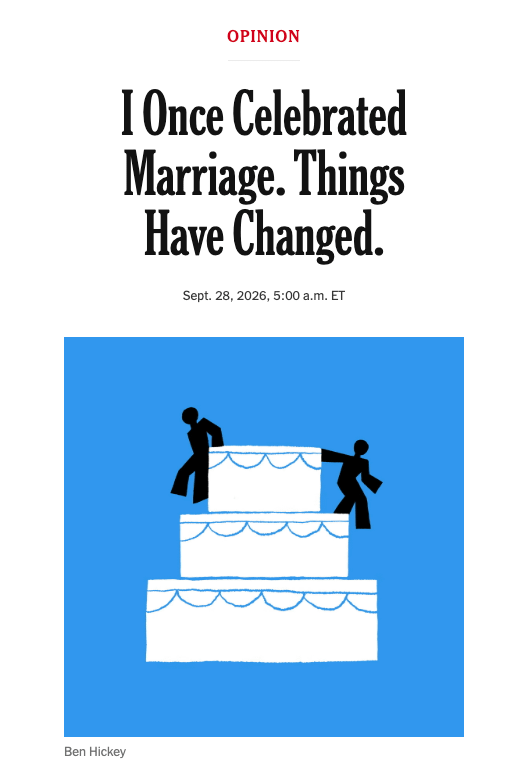
Eleven years ago, on the occasion of the landmark Obergefell v. Hodges case legalizing gay marriage, the Times asked novelist Elizabeth Curtis Sittenfeld to write a “Welcome, everyone, to the right to marry!” column. She’s since divorced, so the paper is running her annotated downgrade of the institution. Note the loony image of two ink-blot humanoids crawling off the wedding cake, as if sniffling: We couldn’t do it! It’s too sad! You may or may not find it significant that the Times decided to revisist the merits of marriage at the same time it printed another rethinking-prior-assumptions piece called, “A Hospital Death Can Be a Good Death.”
The last few years have seen a spate of features and columns and TV segments describing “exhaustion” between the sexes. Headlines both in the media mainstream (tending to the anti-marriage position, i.e. “Women aren’t too picky to date. They Just don’t need men to feel fulfilled”) and on social media and YouTube (tending in the other direction, e.g. “Women actually NEED men. Here’s why”) have increasingly assumed a martial tone, with groups lining up to do battle over whether or not men and women need one another.
The UK paper i was typical in embracing the theme of “heterofatalism” as a left-right matter, in which misogynists are “fuming” that women are finally admitting they have “zero interest in living with a man who will mess up their scatter cushions, eat all their food, and try to shag their friends.” The tone of the new Times piece isn’t as political, but like so many of these pieces, it’s remarkably pessimistic and joyless. The word “love” does not even appear in the body of the 2015 piece, which was supposed to be the passionate pro-marital proclamation.
In the original article, Sittenfeld instead compared the decision to marry to the question of whether or not to bring a cardigan on a walk. The answer is yes, because when the temperature falls below 70 degrees, and “I didn’t bring a sweater, I usually wish I had.” (Yes, her husband is the cardigan in that metaphor.) In the annotated update, a changed Sittenfield asked: “Maybe, between perimenopause and climate change, I no longer need to bring a sweater?”
Her other observations about marriage included noting that it confers major financial and legal benefits, but also “less tangible” ones, like that “it’s reassuring to officially have an ally, or extra cushioning between the individual and a sometimes harsh world.” In other words, it’s better to have a husband than not, like that cardigan you take on a walk in middling weather.
That’s a remarkably grim endorsement not just of marriage, but romance. Nobody who’s been in love or even dreamed of it would think this way. The very idea has been a joke for as long as people have thought about the subject. In Much Ado About Nothing, Benedick and Beatrice spend the early part of the play declaring themselves immune to romance, only to have a smitten Benedick declare in the end, “The world must be peopled!” In real life, love hits like a hurricane, and no one has time to ask the “need” question.
But you’ll constantly find the word in headlines about romance now: here and here and here and here and in a million other places. The issue of need was always obviated by the fact that men and women so clearly wanted to be together. No one needed to leave an instruction manual for audiences to understand the Katherine Ross-Dustin Hoffman ending in The Graduate — people have always instinctively wanted to ride off into the sunset in someone’s arms. For men and women, searching for and ultimately finding that person has always been one of the great joys in life, far above pragmatic questions, a thing for poets and artists to describe, not social scientists.
Are men and women really so “exhausted” now that they can’t be happy together without the glue of “need,” or are we just being lied to, again, by a cultural elite that demands that everyone else to be as miserable as they are? It has to be the latter again, doesn’t it?
A good starting point with this question is a reminder that one of the dumbest media errors in modern memory started the ball rolling on a lot of these “do we really need love” articles:
