

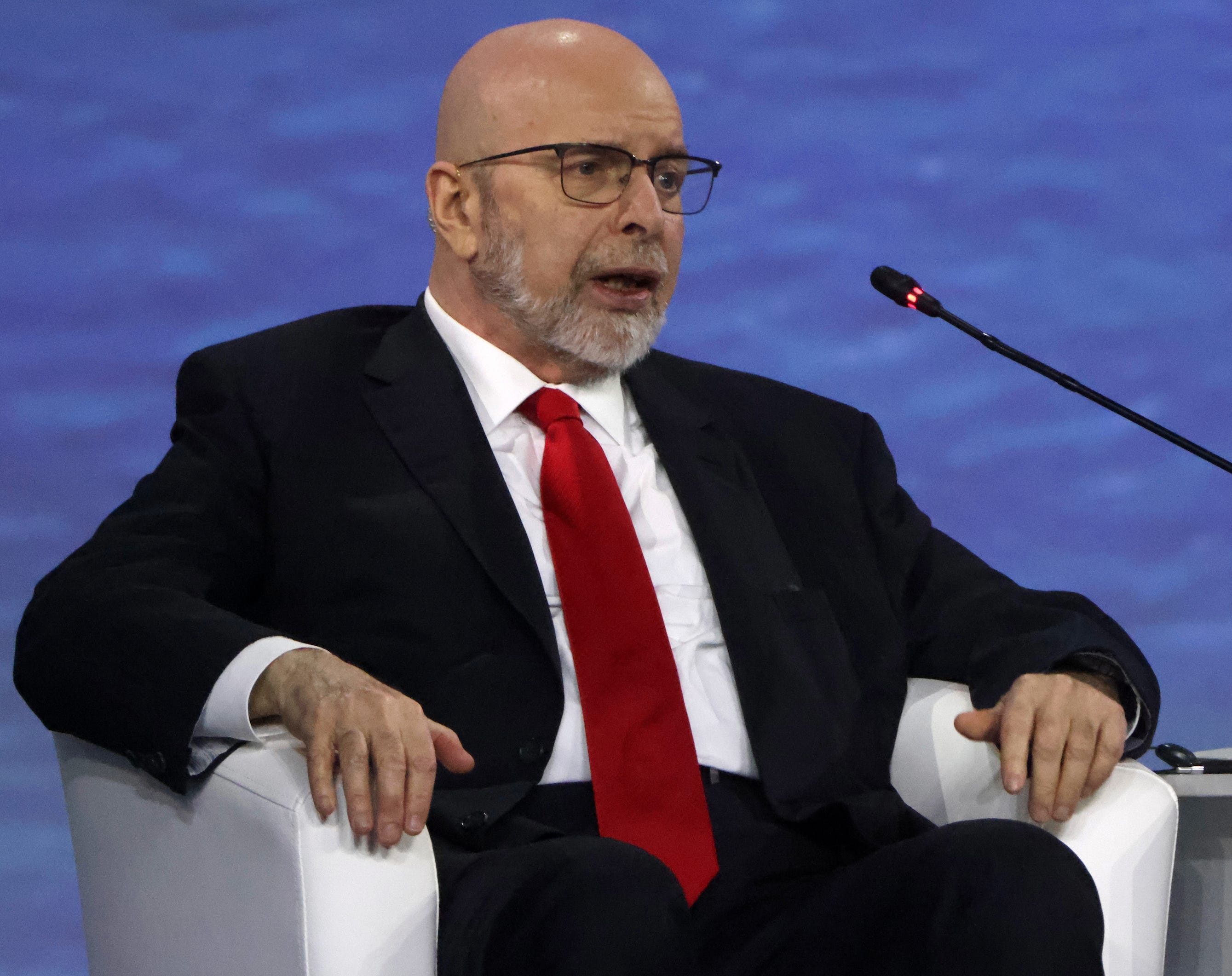
Last week, the New York Times ran an alarming house editorial called “Politicians Are Trying To Control The News,” outlining how the “shadow of press repression” is now expanding to “onetime bastions of press freedom” like Hong Kong, Israel, and Donald Trump’s United States. Written in the grave tone the paper brought when it published a history-altering essay by Soviet dissident Andrei Sakharov fifty years ago, it was all true, except it left out our country’s strangest and most shameful example, one in which the Times played a regrettable part: the case of Dimitri Simes.
In August, 2024, the FBI raided the Virginia home of Simes, who defected to the United States in 1973 after being expelled for protesting Soviet involvement in the Vietnam War. A huge team of agents swooped into the empty home — both Simes and his wife were away — and took almost everything, including an icon “which my mother got from Andrei Sakharov.” For Simes and his wife Anastasia, it was devastating. “Look, I lived in the United States for fifty years,” he said Monday. “It was all our possessions.”
The FBI left one thing. “My handgun,” Simes said. “They put it on my night table.”
A month later, on September 5, 2024, Simes was indicted on a series of charges that have no precedent. Technically, he was charged with violating the International Emergency Economic Powers Act (“IEEPA”), a sanctions regime that allows the president to take action against any “unusual and extraordinary threat” to national security. The law is intended to allow the U.S. to seize or block assets of foreign powers deemed hostile or belligerent, in this case Russia.
The offense that triggered the Simes indictment was that he “continued … hosting and producing the television program ‘The Great Game’ for Channel One Russia, and received compensation and services from Channel One.” Simply put, he hosted a Russian TV program and was paid to do so. U.S. government sources told the New York Times charges were filed “to crack down on Russia’s attempts to influence American politics ahead of November’s presidential election.” Times reporters Julian Barnes and Steven Lee Myers added that the Justice Department believed that Russian President Vladimir Putin had “devised a plan to target swing state voters in favor of Mr. Trump and against further support for Ukraine.”
The Great Game is a political debate show broadcast on Russia’s Channel One in Russian, for Russians. No one in America watches it, in swing states or anywhere else, but even if they did, it’s still extraordinary that the Biden government charged an American citizen in criminal court with the overtly political offense of potentially supporting his opponent, or opposing American involvement in the Ukraine war. Anyone reading that September, 2024 New York Times story would assume that Donald Trump by now would have handed Ukraine to Putin, and certainly dropped the charges against Simes.
Neither proved true. Simes remains under indictment, threatened with forty years in prison, for the crime of hosting a Russian TV show. It’s not a partisan problem, as this case (like the Assange case) was brought under Democrats and continues to be prosecuted under Donald Trump. Hundreds if not thousands of people in America work for foreign news organizations, some of them for sanctioned countries, but Simes alone has been criminally charged in this way. Why?
One of the lawyers for Simes is the eminent Michel Paradis, well known for representing Guantanamo detainees and for authoring a number of provocative books, including most recently The Light of Battle, about Dwight Eisenhower’s role in building America’s superpower status. I asked Paradis if there was any precedent for criminally charging someone for working as a journalist. Typically in speech offenses the ostensible offense is different: incitement, discrimination, causing harm, etc. With Simes, it was his employment status alone.
“It is a totally unprecedented use of the sanctions laws,” said Paradis. “The closest
analogies over the past 100 years are the prosecutions of John W. Powell for sedition for editing China Monthly Review during the Red Scare (which ended in a mistrial), and of Tokyo Rose for treason during World War II.”
Simes was pursued relentlessly in the Trump/Russia investigation, but the government never found wrongdoing. The biggest revelation about him in the Mueller report, in fact, disproved two media myths. After Trump was elected in 2016, Alfa Bank Petr Aven attempted to set up a line of communication with the new president by reaching out to former U.S. Ambassador to Germany Richard Burt, who in turn tried to broker a connection to team Trump through Simes.
Simes refused, in an episode that showed that pre-election hysterics about a “secret server” connection between Trump and Alfa-Bank were wrong. Moreover, as the Washington Post put it, “Russians did not appear to have pre-election contacts” with the Trump team.
Simes, long known as the head of the Center for the National Interest think tank, was for decades a go-to quote for journalists from papers like the New York Times and Washington Post, if they needed an insight into Soviet or Russian politics. As a young reporter at the Moscow Times I probably called him a half-dozen times, along with most other staffers. Now the onetime defector is back in exile in Russia, and the American press that asked for favors repeatedly has abandoned him as a politically inconvenient colleague.
Simes is comfortable in Moscow now, but is fighting his case not just for the right to return to his adopted country, but for the sake of the First Amendment and the rule of law itself. “If I were to remain silent, there would be a false impression that things like this are okay, that you can do it with total impunity,” he says. “That’s wrong.”
The rest of my conversation with Dimitri Simes, with whom I spoke for the first time in three decades Monday, is in an audio file below, followed by a transcript:
Matt Taibbi: Dimitri, thank you for joining me. I’m in New Jersey. Where are you right now?
Dimitri Simes: I am in Moscow.
Matt Taibbi: But you are an American citizen?
Dimitri Simes: Yes, but I’m also a Russian citizen.
Matt Taibbi: Can you just share a little bit of your history?
Dimitri Simes: Well, let me say first, I was not a Russian citizen for a very long time. I became a Russian citizen in October 2022, when I moved to Moscow full-time. Before that, since 1980, I was strictly a proud American citizen. I came to the United States with my first wife, in 1973. And we lived, at first in Virginia. Several months after we came to the Washington area, I got a job at the Center for Strategic and International Studies, where I was at first a senior fellow, then became director of Soviet Policy Studies.
I was there until 1980, then moved to the then-created, Foreign Policy Institute, and I also was there for about 10 years, as a research professor of Soviet Studies. And in 1983, I went to the Carnegie Endowment for International Peace, where I was until 1994. In 1994 Richard Nixon asked me to become CEO of his newly created center, so that’s basically my employment history.
Matt Taibbi: And that became the Center for the National Interest?
Dimitri Simes: That became the Center for the National Interest.
Matt Taibbi: One of the ironies of this whole story is that you were one of the most quoted people in the American press, whenever reporters wanted some insight into either Soviet or Russian politics. Is it fair to say you were very frequently called?
Dimitri Simes: I think so. I was frequently quoted. I also had dozens of articles in the New York Times, Washington Post. I certainly cannot complain about being able to share my views.
Matt Taibbi: What is The Great Game, and when did you begin hosting it?
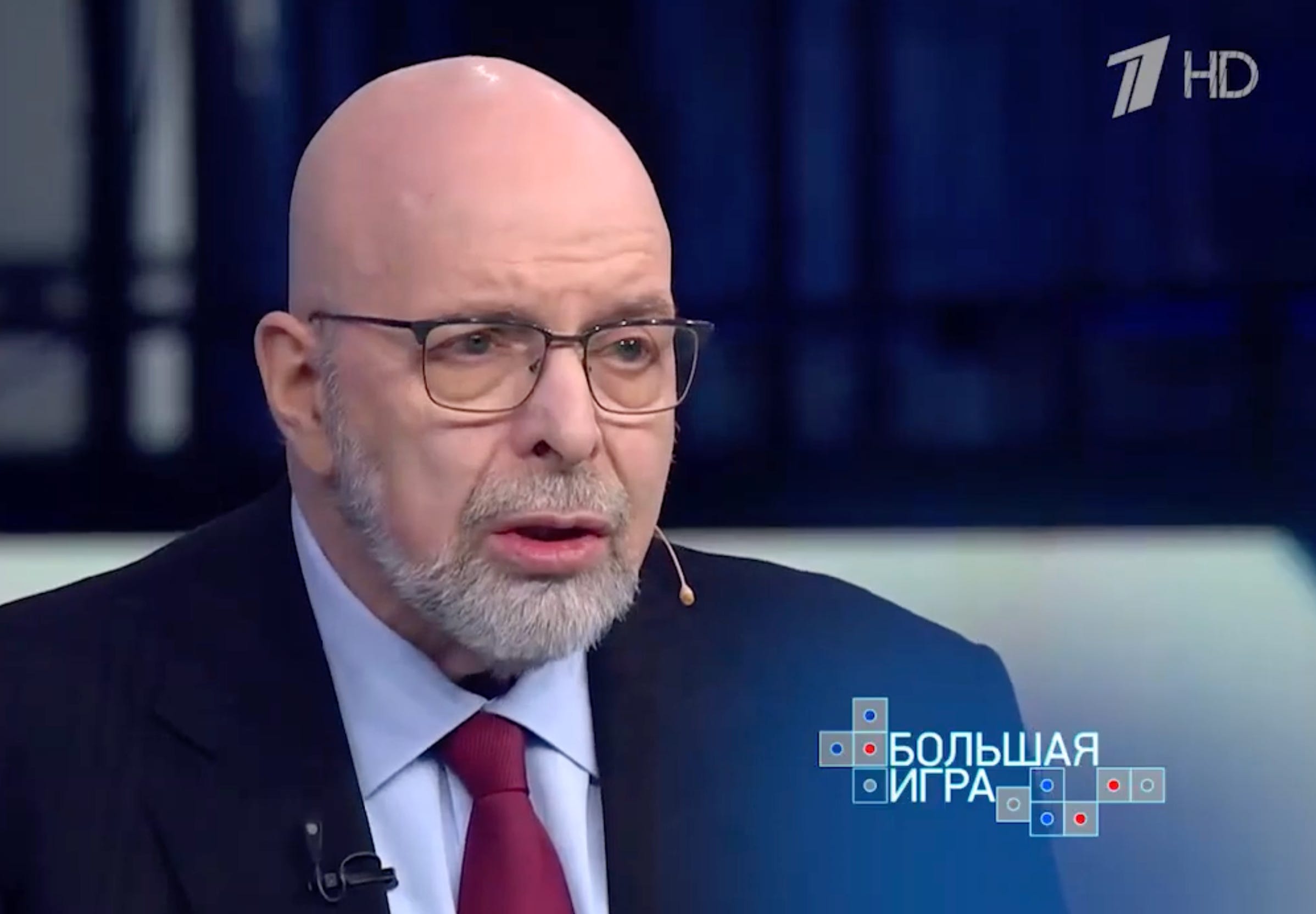
Dimitri Simes: It was in 2018. I was invited by Channel One to become one of two hosts. Initially, they envisioned it as a debate between Russian and American states.
And, on the Russian side, they selected Vyacheslav Nikonov, who is a prominent deputy in the State Duma, and [Soviet statesman Vyacheslav] Molotov’s grandson. As the first channel put it on the channel website, Vyacheslav, he was presenting the Russian position. I said at the outset that I could not present anybody’s position but my own, so it was stated delicately that I was explaining in American position.
Matt Taibbi: But you were there, essentially, to explain what you thought the American position or the Western position might be in the debates.
Dimitri Simes: That is correct, when we originally talked about the program, I shared it, obviously, with the center leadership. And they came to a conclusion, only Chairman Henry Kissinger and then Chairman General Boyd, they came to a conclusion, that, they did not want it to be just my own project.
And, the board voted, and they made it, an official initiative. And I volunteered that I would considerably cut my salary at the center to make sure that it would not look like, you know, I was enriching myself from that endeavor.
Matt Taibbi: Just to back up a moment, so that was in 2018. You were a supporter of Donald Trump in 2016, is that right? Can you explain why that was the case?
Dimitri Simes: Well, first, let me say, I was clearly supportive of his approach. I did not vote for him. I did not vote for a very simple reason. I was, at that time, the publishing CEO of The National Interest. And I thought it would be inappropriate for me to vote in any presidential elections, whatever personal preferences I could have. But I certainly, liked, basically, Trump’s approach.
I was, before that, an informal advisor to Rand Paul. And, I knew Paul fairly well. I did not know Trump at all. It was kind of news to me that he would consider himself a presidential candidate. But I basically liked his foreign policy approach.
I wasn’t sure that he had much of a chance, but I thought it would be helpful to foreign policy debates to have somebody like him presenting his perspective. And then I was at a luncheon at the CNN Time Warner headquarters and, Jeff Bewkes at that time was the chairman, and he was a member of our board. And Richard Plepler was another very active member of our board, and he was CEO of the home box office. So they organized a small fundraiser at the center. Henry Kissinger spoke, and explained how wonderful the center was. And said some kind of words about me, and basically, it was a small, intimate fundraiser.
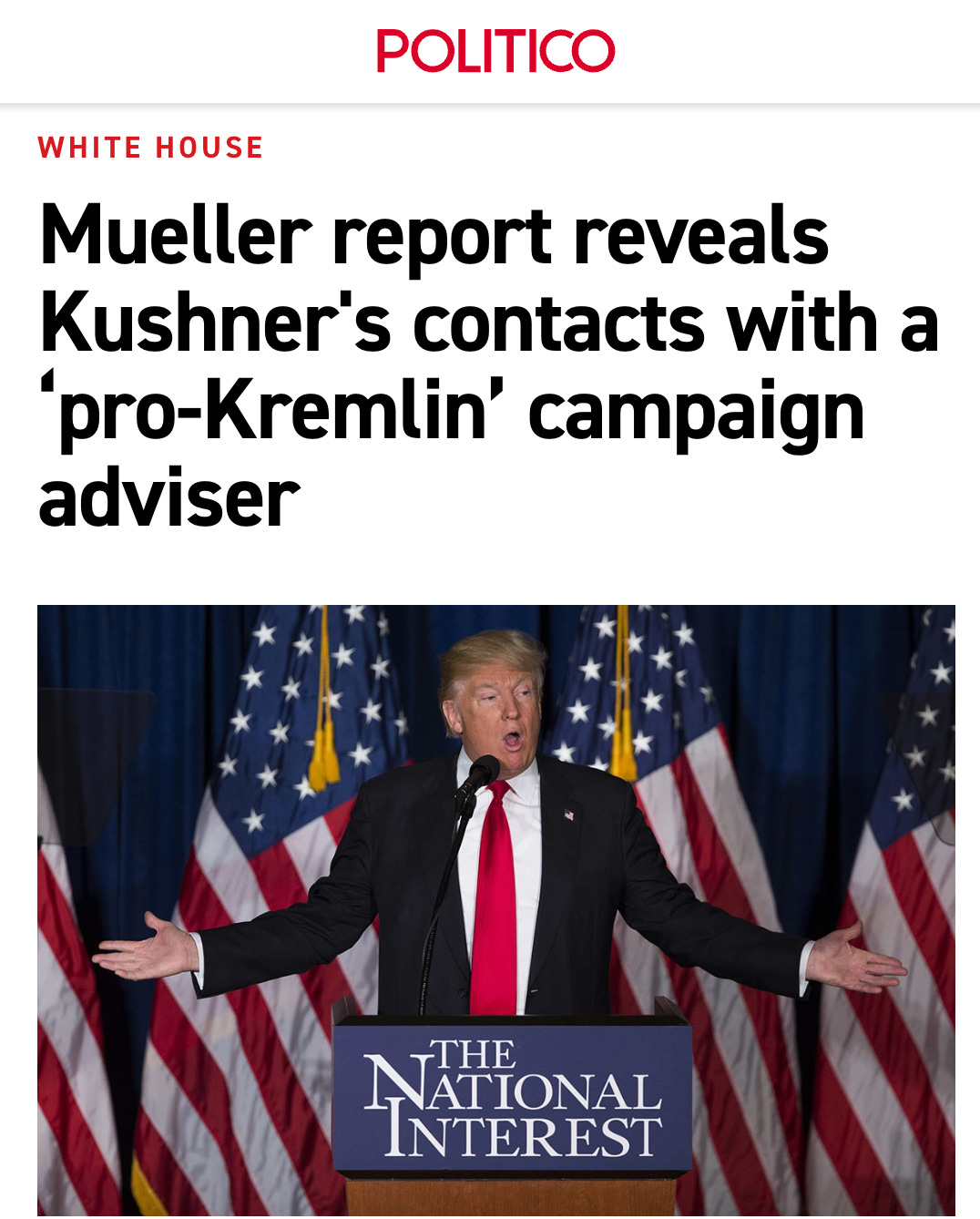
A young guy came up to me, and said that, his name was, Kushner. And that he was pleased to be acquainted, and could we talk sometime? And, I said, sure. And so when, next time I came, to New York, which was in a couple of weeks, we got together, and then at the end of the conversation, he said, ‘You know, we have a possible project for you. Would you be interested in Trump delivering a foreign policy speech at the center?’
And, I said, of course, as long as it is not a partisan speech, and as long as it would be in the framework of what organizations like ours normally do. And we talked about that, and I thought that we had a good understanding. And then Jared asked me, he said we got a foreign policy team, advisory team. But then he said we had to put it together very quickly, because everybody was asking, who are our advisors?
We brought a small group of advisors, but that was not necessarily the best we could do. And we talked about creating a small and informal advisory group. We actually agreed that we would not even call it an advisory group, because some people in this group were not Trump supporters. And they could say things which would not make a campaign very comfortable. So, it was a group of foreign policy consultants. And Jeff Sessions, he was in charge of the national security kind of group in the campaign.
And it also so happened that he was a member of my Senate Advisory Council, and we were good friends. So he took it, basically under his umbrella. That’s how I became involved with the Trump campaign. It was, a very informal and a very loose involvement.
Matt Taibbi: The only reason I ask that is because of the events of 2024, and what happened to you, the way it was explained later. Before we get to that moment: did you have an inkling in Joe Biden’s first term, that you might have to make a change to the way you did business or changed your schedule as a journalist?
Dimitri Simes: Well, the US-Russian relationship was deteriorating very, very quickly. In addition to that, my ability to express my views in the United States was declining, very, very quickly. I still could publish in The National Interest. But basically, not much more than that.
Matt Taibbi: They weren’t taking your calls if you wanted to submit an editorial or that kind of thing?
Dimitri Simes: You know, it was not like that. It was not like, I was submitting and they were not taking. It was almost everywhere. They got new opinion editors. And it was very clear that they were taking a different direction. I had a couple of pieces with my friend and co-host, Graham Edison, who was a member of our board. I had a couple of pieces in the Wall Street Journal with General Boyd, who was chairman of our board.
But it was very clear that there was no space for somebody with my views. You know, you don’t need to be told we will not accept your pieces. It was pretty clear that I could see that some people who were coming weren’t very enthusiastic to send me to events. We were not doing it anymore. Nobody told me that I was subjected to cancel culture.
But, you know, if you’re subjected to that, you don’t need to be told.
Matt Taibbi: Which views in particular do you think were the most unwelcome?
Dimitri Simes: That it was possible and desirable to have a normal relationship with Russia. The notion that the Russian-Ukrainian relationship was very complex. And, to say who did what to whom at what point. It was not a very easy exercise.
In Moscow, I also discovered that people who were very willing to come as our guests. Including from the Atlantic Council. And I allowed them to say on the program that Putin was a war criminal, to say all kinds of controversial things on Channel One.
But I could see that their willingness to take part in something like that in the Russian TV program was, kind of this ruling this was declining very quickly. Also, I had a very good relationship traditionally with, the assembly in Moscow.
And whenever I would come to Moscow, I always would see, whoever was an ambassador, and they would give the dinners, lunches for me, and etc. And particularly with, Ambassador Huntsman who used to be a member of the Central Board of Directors.
And I spoke at his embassy a couple of times in different formats. And I talked to him, and his Deputy Chief of Mission about my interest in taking part in the program. And initially, Huntsman was very supportive, with an understanding that, obviously, I would not be pretending to express official U.S. opinions.
And I think that, Huntsman thought that my views were pretty mainstream. But then clearly somebody told him something. And they made very clear that, no, they would not support the program in any shape or form. And, basically, said that they hope I would not do it.
And, you know, I was a kind of already planning to do it, and I never was a government official, precisely because I did not like to take guidance from government officials.
And the more I talk to Channel One, the more I was beginning to believe that I would have considerable autonomy.
So, there was a kind of a process of my natural exclusion from the American elite foreign policy mainstream. And I don’t think, you know, it was one step. It was a process.
Matt Taibbi: So I wasn’t planning to ask this, but you obviously, you lived in the United States for a long time, and one of the potential benefits of having your voice in front of the American public, particularly after the war, but even beforehand, would have been to provide some of the history and background of these situations. How would you assess the American public’s knowledge of things like the history of Russian-Ukrainian relations?
Dimitri Simes: Well, I found it almost non-existent, but there was something else, more problematic for me. What was more and more problematic for me, was that the new generation of American foreign policy elite, did not know history, and did not try to understand history.
When I came to the United States I very soon met, Paul Nitze. And, you know, Paul was considered a great headliner. But I could talk to him, because he, he went through the Cuban Missile Crisis, because he remembered World War II.
He understood why it was important to have, at a minimum, a normal relationship with Russia. And he also, he understood, that the Soviet Union, at that time the Soviet Union, to put it mildly, was not a very attractive country.
That’s why I decided to immigrate. But he also understood that this was not black and white. And even somebody like Reagan understood it. And they asked me to help him to prepare for his first meeting with Gorbachev.
And I was very impressed how he tried to understand what makes Gorbachev tick. And, try to understand Russian perspective. I think at a certain point, this perspective became less and less relevant in Washington.
And I don’t mean that they had to accept it, but I thought it would be useful to understand it. So, I do not think that, again, there was one reason for my estrangement from the American foreign policy elite. But I will say that, obviously, it was a kind of, an action-reaction process, on both sides.
Matt Taibbi: In August 2024, and then shortly after, in the first week in September, first, the FBI comes to your home. Can you explain the sequence of events and tell us a little bit about that? Were you surprised? What was your reaction at that time?
Dimitri Simes: Well, I don’t know what term to use. I was shocked… But I also knew that nobody else, and there were plenty of American citizens working for Russian federal channels. I knew that no one else was in any kind of trouble.
I also knew that I was never told by any U.S. government agency, that I was doing something wrong. I had a very good lawyers at that time.
And they did not tell that, that I had, any problem. And basically, the assumption was at first, as the State Department was explaining at that time, including publicly, that those, sanctions, they were not directed against journalists.
Their purpose was to deprive Russian federal channels, which were considered propaganda channels. The purpose, we were told, was to deprive them of American financial support.
And since Channel One did not broadcast in the United States at all at that time, clearly, I in no way was involved in any financial support for Russian official TV.
But second, I thought that what I was doing was pretty objective, that I had disagreements with Russian officials, on there, including with no less than, President Putin.
Matt Taibbi: Whom you interviewed also in 2023?
Dimitri Simes: Yes, but I was on a panel with him considerably earlier, and we had a disagreement.
So, I did not think that I would be a likely target of something like that. I fully understood that I was not a very popular man in Biden’s Washington.
But certainly, the idea is that the FBI, suddenly would come to my home. And it was totally unexpected, and they knew that I was not in the United States. They knew that my wife was not in the United States. You know, if they really wanted to arrest me there was, there was every reason for them to wait a little bit, and that I would come for a visit.
Matt Taibbi: Right.
Dimitri Simes: So, I couldn’t entirely understand what was the purpose of that, unless they had a reason to deprive me of an opportunity to come back to the United States and to make some kind of political point. I don’t know.
Matt Taibbi: So, let’s talk about the charges and what they were alleging. When the FBI came and raided your home first, and then subsequently charged you criminally.
The charge was essentially violating the International Economic Emergency Powers Act, or IEEPA, which is a sanctions regime. But what’s unusual about it is that the overt act here was, if I’m reading correctly, it’s hosting and producing the television program The Great Game. So, you were essentially accused of violating a sanctions regime for hosting a TV program. Is that right? Am I interpreting that correctly?
Dimitri Simes: No, that’s exactly right. There was also a second charge. And that was money laundering.
And I thought it was quite a remarkable charge. Because, they were not alleging that I was involved in any financial transactions. All they have alleged, and that was true, that I was paid my salary in Moscow.
And incidentally, this was one of the banks that had an agreement with the US Treasury, so if there was an American citizen, they were providing full information on their salary, and on all their transactions. So, presumably the FBI could see very easily that I was getting my salary, and that I was using this salary to pay my mortgage in the United States, but most important, to pay my taxes.
I was, paying hundreds of thousands in taxes, in federal taxes. And, I did not have that kind of income… in the United States anymore. So I was, paid by Channel One in Moscow, and I was, transferring the money to my account in Washington, to pay my taxes. It did not occur to me — I guess I didn’t have enough imagination, that it could be considered money laundering.
Matt Taibbi: I’m still confused about this part. How is that money laundering? I vaguely understand what they’re trying to say with the sanctions.
Dimitri Simes: In their view, it was, illegal for me to work for Channel One. Accordingly, my salary was not a legal salary, so if I was using this illegal salary to pay American taxes, which they were dutifully accepting these payments for several years. Without any questions. Without any audit. And then suddenly it became money laundering, you know?
Normally, if there is a problem with your taxes. Normally, IRS would ask you, would raise questions, would warn you. I never had an audit in my life. So you can imagine that I was extremely, extremely surprised. And I also could not imagine what was it that they expected to find there.
What could they conceivably find there? They, confiscated, they said that they were, taking things which they suspected I got illegally, meaning that I used my salary in Moscow to buy these things in Washington.
But the house was bought before U.S. sanctions against Russian radio channels. Most of our cars were bought before that. And practically all our paintings and antiques were bought before then. The most valuable paintings and antiques, actually, I have inherited from my parents. There was a very beautiful and expensive icon, which my mother got from Andrei Sakharov. My mother was a prominent human rights lawyer.
And there were some paintings which my parents got from Moscow avant-garde artists, because again, my parents were considered very supportive of dissidents. And they took all of that.
There was one thing which they did not take.
Matt Taibbi: What did they not take?
Dimitri Simes: My handgun. They put it on my night table.
Matt Taibbi: You think they were trying to send you a message?
Dimitri Simes: Well, nobody would think that if the FBI comes to your home, and they find a weapon … It was a Sig Sauer, a pretty good gun used by U.S. Special Forces. And then they did not take it, and they did not ask any questions about it.
Matt Taibbi: These things must have had an enormous personal meaning for you.
Dimitri Simes: Look, I lived in the United States for 50 years. All my life, my wife for 30 years. This was… this was, all our possessions, and they did damage to the house, they were breaking the floor, they broke the roof.
It’s about 40 people team, to take what in this operation? There were trucks coming, you know, to remove our property.
Matt Taibbi: What’s so fascinating and disturbing after this raid that had so many people take part in it, and after, there were leaks to newspapers, in particular, the New York Times. And then subsequently, when you were charged, you were accused of spreading disinformation and state-sponsored narratives, and the strong implication was that you were part of a Russian attempt to impact the 2024 election, But first of all, your show is in Russian for Russians, yes?
Dimitri Simes: The show is in Russia for Russians. And the second thing is that even now, during the war, when, obviously, there is less freedom to discuss certain things, even under those circumstances, I will assure you that I never am told what I should use on my program. And I will tell you that I’m never told whom I should invite as being guest of my program. What I would not tell you is that there are no restrictions. There are restrictions. There are restrictions during the war.
Some of these restrictions are necessary, or at least sensible. Some restrictions which I would not always agree with, and these are restrictions if I disagree, which actually is a rare case, I discuss with the channel management. But I most certainly do not accept for a second that I engage in propaganda. Propaganda means that somebody directs me to do something.
That is not… that is not the case, at all.
Matt Taibbi: But they specifically charged you with also disinformation, which became a very vogue term in America.
Dimitri Simes: I’m not aware of any specific example, of any specific example. They did mention, they said something, in their press release about Bucha. There’s only one problem; I have never talked about Bucha. Never, never, ever… Never, ever. So they could not find a single instance when they could say that I engaged in this information.
Matt Taibbi: Do you think, though, that your arrest, the charges levied against you, and the search, do you think that was connected to the election?
Dimitri Simes: Well, that certainly was a part of what Trump calls Russian hoax. And I was probably one of the most investigated people in the United States. I was investigated by the FBI the late 1970s.
And my critics who use this without without mentioning that the result of this investigation was the FBI provided information, to the immigration court, that they hear absolutely no reason why I should not be given a US citizenship. And I was getting a US citizenship, through a congressional act.
So, nobody was obliged to give me the citizenship, before a 10-year period, which was established for people who, like me, were members of the Young Communist League Organization.
Matt Taibbi: Komsomol?
Dimitri Simes: Exactly. And there we are, at that point, gave me, a clean bill of health.
Now, then there was a Mueller investigation. And, if you read all these pages about me, about 100 references, what I think is remarkable is that not only they did not charge me with anything, but we very specifically explained, that in each case, they have investigated my actions had a benign and legitimate explanation.
But interestingly, instead of, saying, well perhaps the guy is really innocent, and perhaps we were, actually, unfairly bad-mouthing him. Instead of that, the reaction was, oh, he has to be really sneaky, right?
This is the [former KGB chief Lavrenty] Beria mindset. If you cannot prove somebody’s guilt, it doesn’t mean that this person is innocent. It means that he is particularly terrible and dangerous.
Matt Taibbi: Show me the person, I’ll show you the crime, basically.
Dimitri Simes: But I understood, that, they were particularly angry with me for one phone call I have received, or at least I was told so, I had very few communications with the United States. Because after I have left, after the work have started, after everything, I did not have too many American contacts.
But there was one specific phone call when, I was told that it would be interesting for me to come to the United States and to share my impressions, of, what was happening in Russia and U.S.-Russian relations.
And, that phone call was, just a couple of weeks, before the FBI would be moved against, my house.
Matt Taibbi: And who invited you?
Dimitri Simes: Well, as you can imagine, I am not at liberty to talk about that. All I can say that this was not a U.S. government official. I actually did not even decide that I would be coming to the United States at that time, because with everything, that was going on between Russia and Ukraine. I was asked by the channel to continue working, throughout August. So, it wasn’t like I had any immediate plans at the time to come to the United States.
But I found it interesting, that when I… when I was thinking what could prompt this indictment. That was the only thing, that, came to my mind. Obviously, if I came to the United States, I would say some pretty critical things, of, the Biden administration conduct at that time.
Matt Taibbi: And you might have been arrested.
Dimitri Simes: So, at that time, it did not occur to me that I would be arrested. Well, it genuinely did not occur to me. There was… the Department of Treasury, if they think that somebody who violated sanctions, they normally would, send them a questionnaire, send them a warning. There was nothing like that. You have, to appreciate, that I was not doing anything secret. I was not hiding anything. Everything I was doing was an open book.
So, if, there were serious concerns about my activities. It was very easy to express these concerns to me directly.
Matt Taibbi: I have just a few more questions. Can you help explain to American audiences why they should pay attention to your case, because it seems you’re being charged with being employed as a media figure for a country that has fallen in disfavor with the United States. You’re not accused of doing anything secret, you’re not accused of having said something libelous…
Dimitri Simes: I am not accused of any contacts with Russian security services. And I have none. Everything I’m doing is pretty public. I do talk to Russian officials; that’s a part of my job. Mostly, it would not be them calling me, but me calling them, because I try to be sure I understand, the official perspective, obviously, before I go on there.
But I do, you know, I was CEO of an influential foreign policy magazine. I know how to ask questions, and how to try to confirm facts, and I’m not doing, in Russia, anything beyond that.
Matt Taibbi: So, but it seems to me your case could impact not only other employees of other state media organizations, but also American employees of other American employees here in the States, of state media?
Dimitri Simes: Well, first of all, let me say, in my view, precisely because there are no charges of espionage against me. There are no serious charges of disinformation against me. I don’t know what are the charges against me, except sanctions for elections.
And in this case, there happens to be the First Amendment, which should be above executive guidance from the Department of Treasury.
That’s not to say that I could violated even that, but still, there is the First Amendment. And I think the casual attitude to the First Amendment and, threatening me with 40 years in jail, I think it’s a very, chilling, message to any American who is expressing his views. And an argument, well, that’s not because of his views, but because he was paid in the process.
The Founding Fathers were very specific about that, that they were trying to cover political activities, and most people who engage in politics and in professional journalism they’re paid. So, I have to say, this is a very chilling a message to anyone who wants to express his views.
But let me say also something. I, tried during all this period. Not to raise my case seriously.
I have a very, comfortable life in Moscow. I, like a lot of people, and, I always wanted to have a TV show. Actually, it was my dream. And, suddenly, when I was well in my mid-70s, this dream, came through. And now, I’m anchoring one of the most, prominent political programs in the country, and they’re doing it 5 days a week. I am also a professor at MGIMO, you know what MGIMO is?
I’m not asking anyone to have pity for me. But I think it’s, not normal. I think it is not just, that I, can, cannot come back to the United States. And that if somebody is interested in my views, that they would be able to ask me questions. And last but not least, they are, constantly complaining in virtually every administration that Russia arrests Americans citizens, that Russia is using these people, as hostages.
And they say that this is unfair and politically motivated. And I will ask you a rhetorical question, if I came to the United States and they arrested me. And they put me in jail. Wouldn’t they think that it contradicts U.S. official notion that things like that should not be politically motivated, and shouldn’t they at least entertain a possibility, that there may be an American who could be in trouble as a result of that? And I’m not even talking about an innocent American, because there are a lot of Americans in Russia, and there are a lot of regulations in Russia, I’m not saying that it should be illegal and selective. I should say that it obviously, is, influenced by perceptions. What kind of relations you have with this particular country, and what, could be the implications of your actions?
And I’m sure that they would say, tell you at the State Department, that if Russia would ask, a prominent American journalist, there would be consequences, right?
Matt Taibbi: One would think.
Dimitri Simes: I would think, and I would not necessarily have issue with that, up to a point.
But they clearly are creating a situation, if they had their way with me, that probably would not, would not be, very fortunate, probably it would be very unfortunate for me.
But I think that it also could be unfortunate for somebody else. And it is surprising how many people in the U.S. government do not think at all about consequences of reactions, and do not think that there is a possibility of a kind of a response they would not find very welcome.
Matt Taibbi: That leads to my last question. You’ve chosen to defend yourself, your court case is proceeding. Obviously, you have your own interests that you want to defend yourself, and your good name, but is it also for the sake of the First Amendment, to show that its importance? I just wanted to ask about your motivations.
Dimitri Simes: But let’s be very clear, for a very long time, I could raise this issue, and I suspect that I would find some enthusiastic audience in Russia. I have never done it, because I saw that there are enough troubles between the two countries, for me to bring my personal case as an unnecessary additional problem, even if it is a very significant problem. But I also thought that what was done to me was done, for, political reasons, that this was a part of the Russia hoax.
And that, I thought that this could be kind of things which would be addressed by the Trump administration, and now, now I see that, President Trump said on many occasions it’s all, Russian hoax, Russian hoax, it’s all Biden, Biden, and that, he would never do things like that.
And, I have an impression that if I would remain silent, there would be a false impression that things like that are okay and that you can do it with total impunity. That’s wrong, and I like to believe, that, what I’m doing is a public service.
Matt Taibbi: Mr. Simes, Dimitri, thank you very much for taking the time to talk.
Dimitry Simes: Thank you.
And then all the FBI agents involved in the case were fired, charged with violating the first amendment, breaking and entering, and were summarily sent to 10 years in prison each, right?
Bad enough that governments do what they do, but true shame hangs on the NYT for failing to stand up for the 1A. Cowards.