

Today is a big day at Racket, a changing of the guard, with a reboot centered on investigative journalism.
First, to be clear: I’m neither leaving nor reducing my workload. If anything, subscribers will see more of my writing going forward. America This Week with the irreplaceable Walter Kirn is also staying, albeit on a different schedule. Another reason for change is to give me more time to work on long-form stories, the first of which drops this week. However, we’re also adding staff and new content, and the expanded operation needs to be run by someone younger, stronger, and less recently concussed than me.
Hiring Emily Kopp as Editor-in-Chief isn’t just about managerial energy. Probably best known for work into the origins of the Covid pandemic, when she mixed traditional source development with aggressive use of public records laws to draw out links between the virus and American gain-of-function research, Emily is full of what people in the business used to call “reporter DNA.” This personality type may be nice or a raving lunatic in private, but is focused on stories, unable to relax if details feel wrong, and likely to become difficult with anyone who gets in their way.
I started following Emily when I saw her byline at the U.S. Right to Know, a subject of this site’s “Meet the Censored” series years ago and a major factor in publicizing the existence of the aforementioned gain-of-function program. Her work at USRTK demonstrated tenacity and the ability to follow a complex, evolving story. Some of my older mentors pointed her out during this time. Since leaving USRTK to join the Daily Caller, she’s continued breaking stories but has also been at the center of controversies. Some of those involved close friends of mine, who’ll surely call in a rage this week, or maybe stop calling, who knows.
Those episodes, though, were the reason I started thinking in this direction. Emily isn’t a hot-taker and doesn’t seem motivated by getting her face on TV (an anti-Taylor Lorenz?). She just loves the job, and when she gets on a story she believes in, she’ll challenge anyone, even her own sources.
My weakness has always been that I don’t do that, at least not enough. The list of effective laid-back investigative reporters is comically short, like the famed Airplane! joke about great Jewish sports heroes. You either have that get-tough gene or you don’t. I don’t, but there’s more than one way to skin a cat.
Take this week. I’ve got a great story, one I had to go to Switzerland to get, with a terrific source and fascinating documents. I thought it was about Russiagate. It turned out to be about something bigger and more complicated. That thrilling moment where you realize you need to learn a whole new world to make sense of something, while a mess of information is sitting there waiting to be untangled, is why I fell in love with this job. I love the learning, the talking, the studying, and especially the writing. When I get to jump down one of those rabbit holes, not knowing how deep it goes, I’m truly happy, pottering in a private abyss, as another writer once put it.
Like anyone I’ll pull my head up to notice something going on in the news or in politics, but I don’t care about those things, not the way I care about figuring out that one story. Most good reporters are like that. Emily is like that. The stories that interest her might be different than the ones I like, but the instinct is the same. That’s what I want to cultivate here, whether my friends like it or not.
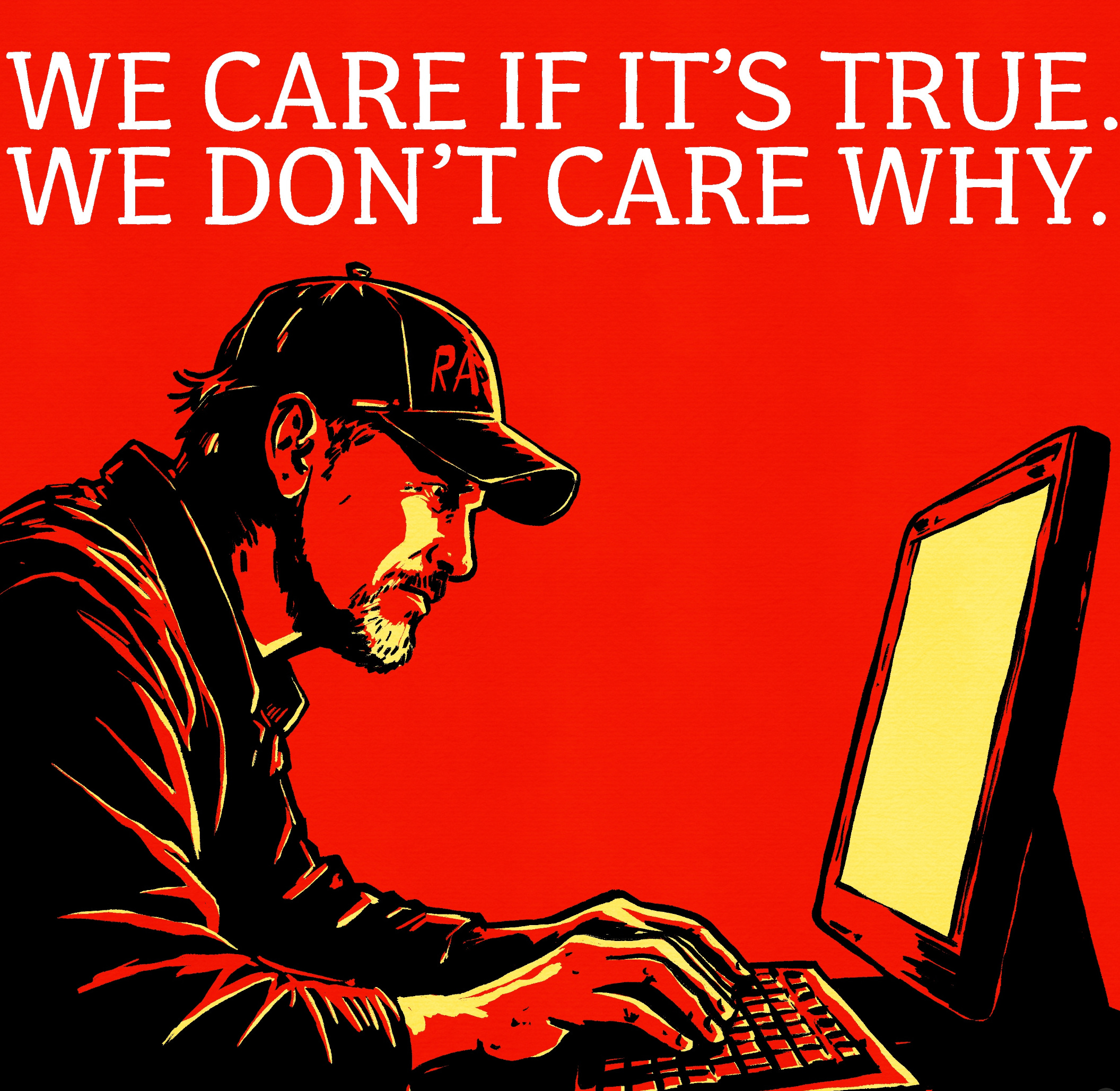
The idea is to build Racket up into a home for reporters. Emily’s remit is to hire more people like herself and give them freedom to just follow their noses, in keeping with a new slogan: “We care if it’s true. We don’t care why.” If it’s true, whatever Emily and new staffers Ryan Lovelace and Caden Olson produce is fine with me. That extends to freelancers and whistleblowers, who should know we’re interested in any exposé that checks out. Caden’s beat is the Washington, Ryan won us over with NatSec pitches, and a list of new contributors will create the framework of a responsive news site, ending the delusion that I can simulate one by myself.
Emily and I have different views, which is fine. It would be weird if any two people thought alike. In most commercial media, however, forcing staffers to adopt slates of positions has become the standard, another pattern we hope to break, not that there’s much risk of falling into it with Kopp. She knows I hate the Epstein story, and you’ll be getting Epstein content right away, which is hilarious and should tell you a lot.
I turn 56 in a few weeks. I’ve watched a hundred trends come and go. When I started decades ago the standard was my father, who wrote just two op-eds in a half century and won piles of awards for genial, articulate delivery of facts. I idolized my father but lacked his interview skill and broadcasting chops and chose the “New Journalism” path, which merged traditional reporting with colorful prose. After a stint overseas I came home to assume the “Hunter S. Thompson chair” at Rolling Stone, where GOP-bashing was assumed but protective editors let me sneak in criticism of Democrats where appropriate, to the point where Barack Obama’s first thought when handed one of my books was to whisper that “he … doesn’t have a very high opinion of me.”
That was the last time that being an “equal opportunity offender” was considered a good thing. In the summer of 2016, I had a premonition the business was about to go through dramatic changes. You can see what I was thinking here. With Donald Trump’s election, an era did end. The newsroom died. Some of it was technology. There was no more need for the wire teletypes or clunky landline phones or typewriter workstations that combined to make that famed All the President’s Men-style din of clacking and ringing over which reporters had to half-shout to talk to sources or insult each other.
The newsroom rule was anything goes, so long as stories held up. There were corollaries: admit mistakes, don’t break confidences, offer chance for comment, etc., etc. Still, the job as I understood it always came down to three things: Be curious, write well, don’t screw up. That wasn’t a lot to ask, which was good, because this was never a business for rocket scientists.
When Trump came along, all that vanished. Overnight, it was decided the ethos built up across a century of American journalism, in my case literally handed from one generation to the next, needed immediate dismantling. Why? Racket readers mostly got to know me during the period when I’ve tried to work through this question.
Some things never made sense. Take the junking of “objectivity.” In 2017 it was suddenly accepted that “mealy-mouthed” neutrality was a mask for institutional biases, and the injunction to include comments from all sides only “platformed” voices that didn’t deserve it: climate change skeptics (cited in every “both sides” story), police spokespeople, Trump.
This became instant conventional wisdom, and worse, arguing for neutrality for any reason — even as a way to protect writers — became taboo, a fireable belief. A new vision took over, under which it was understood that all messaging helped or harmed some political end. Instead of just focusing on the hard-enough job of working stories, all those thousands of midwit minds in commercial journalism were now tasked with weightier questions, like “whose social order you’re maintaining,” as Canadian environmentalist Candis Callison put it.
I knew from experience this wasn’t right. Good reporters don’t seek comment to check a box, but for important human reasons, like fairness. If you’re running a damaging story, you owe it to the person targeted to at least hear out their explanation, if they’re willing to give it. You also make that call because you might just be wrong! That leads to the next issue, humility. Any journalist who thinks that he or she is such a towering font of knowledge that calls to more sources are unnecessary is a fool, and a liability. The fact that you never stop learning in this job is one of its best features. Who’d want that changed?
I’ve come to believe those calls to eliminate “objectivity” or “both-sides-ism” were really about getting people to ignore their natural instincts. Reporters are interested in secret documents the way kids are interested in bees’ nests or water bears. Not for political reasons, but just — because! That’s why people once liked press figures, or liked them more than they do now, anyway. Anyone can connect with raw curiosity. It’s natural. It also demands time.
My father needed a whole day of calls and street conversations to produce a TV script seven sentences long. I always had more space and words to work with, but the concept was the same: find a cool story, ask around, write it up. As the news cycle got faster I got away from this too often, and when I had sons of my own, I began to worry that the whole concept of taking time to consider things would disappear.
I decided the best thing I could do was sponsor a home for reporters and just leave them the hell alone, with the idea that they might carry the idea forward through uncertain times. With Emily, Ryan, and Caden, I think we’ve got three good ones, and I hope they’re just a start.
Racket subscribers have been extraordinarily generous over the years. Because of that I’ve never pressured readers to give more, nor have I played the ham in media appearances with appeals to subscribe. I still won’t do it, but I may ask that readers be a little patient as we figure the right way to pace things. We’ll look in all directions — at Big Pharma, central banks, intelligence, Democrats, Republicans, dogs, cats, whatever — and get everyone who works here engaged both on quick-hitter reports in tune with the news cycle, as well as investigative pieces with longer horizons that take a week or three (or six?) to finish. There will also be some things that aren’t reported but should be useful and informational, like Caden’s Swamp Log, which will be there mainly to help orient readers on Mondays. In the future it’ll be in your in-box earlier, but today is an outlier for obvious reasons.
We’ll want your feedback. You can assume I’m willing to spend to make something work, but we need to hear what stories and other information you want or need to help us decide how to deploy resources. Another part of Emily’s job is to re-boot the FOIA operation, experiment with new formats for features like timelines, and maybe create searchable glossaries so that readers will know whose money is behind the sources quoted in mainstream press stories.
It might take a minute to find a rhythm for all this. If you hang with us in the meantime, I believe you won’t be disappointed. Unless you’re after takes. If you recall anything from today, I hope it’s this: I’ve come to hate “takes” so much, I’m willing to spend a small fortune to never give one again. Racket will try to respond to current news by reporting new angles where possible — we already had a meeting on this — but this site is on nobody’s side. If you’re here to cheer for one political party, or to see your views on issues X or Z regurgitated, you’ll likely find the new us obnoxious. We promise to be the right kind of obnoxious, though.
Welcome to the new Racket. I hope you enjoy the work of Emily and her team, and I’ll see you soon, as I’m not going anywhere. Let’s make this interesting together.
I'm sure I speak for many subscribers when I say I couldn't care less about pacing. Just keep up the good work.
Well alright! This is why i signed up in the first place.
One ask though. Please don't turn into the FP or the Bulwark or the Dispatch with all these new contributors. Or dog forbid the NYT circle jerk format of the op-ed section now. I'm here for investigative journalism, not hot takes and opinion "journalism".