

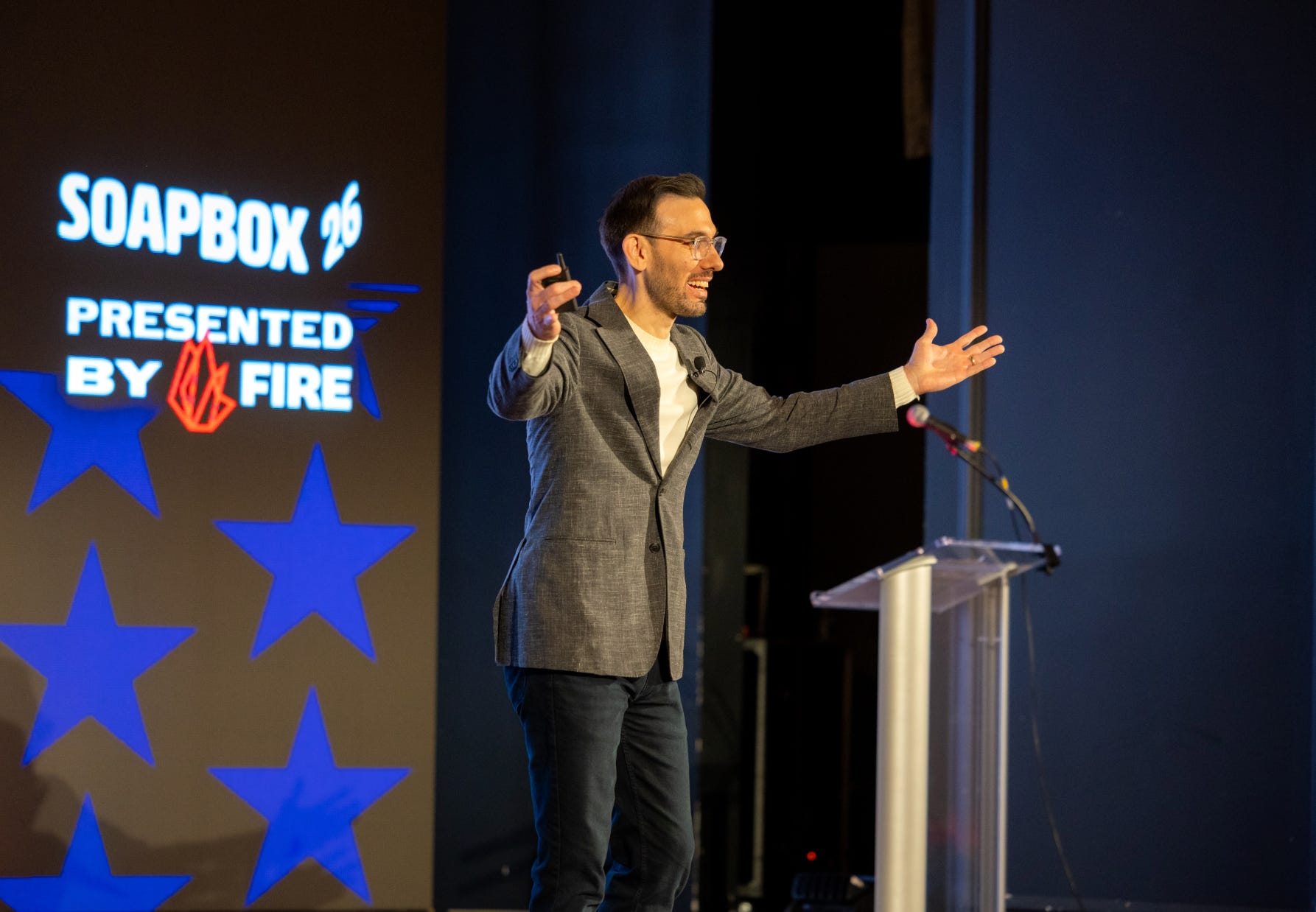
I’m about to leave Philadelphia, where the Foundation for Individual Rights and Expression (FIRE) just held its Soapbox 2026 event, featuring everyone from Afroman to former ACLU President Nadine Strossen to Bob Guccione, Jr. to Comedy Cellar owner Noam Dworman, who as keynote speaker and fellow comedian Adam Edelman noted, didn’t “have the decency” to show up in person.
Virtually everyone who’s been an unembarrassed defender of free speech in America in the last decade-plus was there, which was both the strength of the event and, as Archibald MacLeish might have put it, the “black pall” hanging above the Bellevue-Stratford hotel where the friendly circus was held. Turnout was robust, FIRE has become the legal powerhouse the First Amendment needs, but once Edelman began telling jokes that hurtled the crowd back to an earlier time when none of this was controversial, many attendees — I know I felt this — became unpleasantly conscious of the lonely outlook for free expression.
“The bad news is, this has come down on us,” said FIRE President Greg Lukianoff. “A tiny community defending free speech.”
The good news, as legal director Will Creeley, Executive VP Nico Perrino, and many others noted, is that this has often been the situation across America’s history. In the 20th century the line was held not only by the ACLU of Ira Glasser and David Goldberger (honored with FIRE’s Silverglate award last night) but also the Free Speech League of Theodore Shroeder and muckraker Lincoln Steffens, and the National Liberal League and the National Defense Association before them, and before them the anti-Slavery Society, etc. There have always been advocates to keep what FIRE calls the “spark” alive.
That didn’t change the unnerved vibe among event-goers. Creeley quoted longtime Village Voice columnist Nat Hentoff, author of the sadly predictive Free Speech for Me But Not For Thee: How the American Left and Right Relentlessly Censor Each Other.
“There are two innate human urges, the urge to procreate and the urge to say shut up,” Hentoff once said. “Unfortunately, the latter is stronger.”
That’s far truer today than it was in Hentoff’s Village Voice heyday, when horniness and free speech were still relative bipartisan consensus. That accounted for the confused looks on the faces of attendees, many of whom were old enough to remember The People Versus Larry Flynt, The Last Temptation of Christ, The Satanic Verses, Texas v. Johnson and 2 Live Crew.
“Everyone was for free speech then,” said one donor, shaking her head. “Where have all my friends gone?”
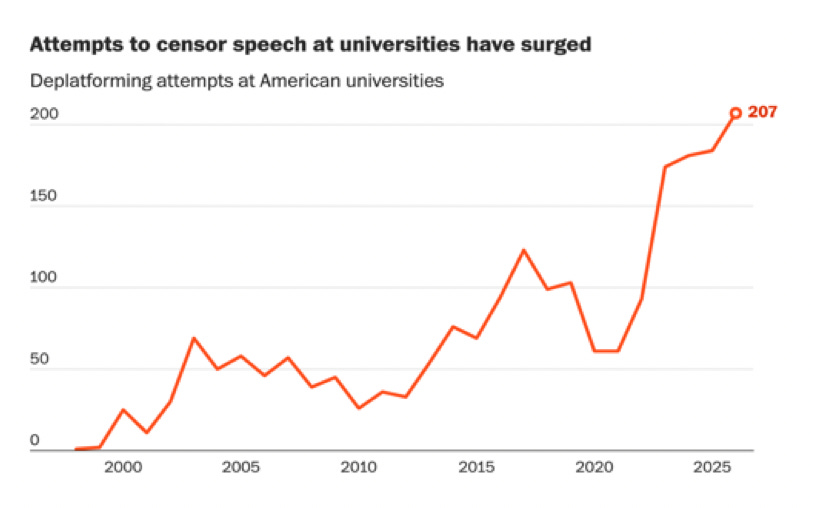
Free speech is in trouble, and problems are snowballing, with the First Amendment now squeezed between competing visions of unfreedom. The massacre of the Republican party at the polls last week was driven at least in part by the Trump administration’s cringeworthy failures on the issue. Evidence for a pattern of tit-for-tat deplatforming efforts abound. Two weeks ago in the Washington Post, Lukianoff noted an all-time high in efforts to shut down speakers on campus. America never saw more than 200 such episodes in a year, but we’re at 207 and climbing in 2026:
Some of this is militancy over Israel-Gaza, a litmus-test issue that also involves this century’s most dependable magic speech-suppressing word, terrorism. Some of it is tied to the idea Hasan Piker celebrated during Tuesday’s Election Night massacre, “Woke is back, baby!”
There’s a bigger problem we rarely talk about, even at events like the FIRE conference. Supporters of civil liberties are becoming a subculture. We’re aging out of the era when Americans reflexively understood why free speech is important.
It’s about more than law. Lawyers are busy now doing things like springing Larry Bushart from a 37-day Tennessee jail stint for posting an anti-Trump meme (his wife joked last night that was a “quiet month”) or keeping professors like the University of Washington’s Stuart Reges out of trouble for spoofing land acknowledgements — it’s “been a lot,” Lukianoff admitted. As a result, there’s little time for extolling the benefits of free speech culture, which is about far more than the right to say unpleasant things. It’s a way of life.
Being free once made us feel richer, even if we weren’t. Other sixties liberation movements became institutionalized elements of American life, but the ethos of On the Road, Easy Rider, and Me and Bobby McGee, about finding joy in charting your own life journey, has all but vanished. My old magazine Rolling Stone, gobbled by the Penske corporation, has drifted far from the “when you ain’t got nothing, you got nothing to lose” spirit of Bob Dylan’s song. There are a few cool YouTube parallels to films like Vanishing Point, about the thrill of jumping in a fast car and just driving like a bat out of hell, but even “no particular place to go” was long ago transformed by Volkswagen from open-road anthem to a commercial for sensible driving.
Speech was under serious attack before 2024 and was a major issue in that year’s election. Donald Trump had a golden opportunity to remind the world why American attitudes about speech are unique and why we’ve historically fought so hard to protect them. He didn’t do it. Instead, Trump barrelled into office issuing orders showing he either didn’t understand the First Amendment, or worse (as Reason’s Nick Gillespie put it this week), he did understand, and didn’t care.
Often, the administration made a show of violating the First Amendment where other presidents would have just done the bad thing quietly, like the case of revoking AP’s credentials over “Gulf of America,” or saying out loud that foreign students were being detained or having visas revoked for speech reasons. Now, absent a big cultural change, we’ll continue down a tailspin of creepy pessimism that’s gripped the country for decades. Lukianoff referenced the problem in his Post article:
Around 2014, administrators encountered a generation of students more willing to demand that professors, classmates and visiting speakers be punished for offending them. My colleague Sean Stevens and I call that relationship the “unholy alliance.”
It’s not hard to find academics to agree that this phenomenon took place, nor is it hard to find evidence of the dramatic shift in attitudes, with young people especially more likely to believe now that the First Amendment goes too far. It’s much harder to identify why these things happened. Campuses were not long ago the last place one was likely to find arguments against the First Amendment. The only place less likely to be the site of an anti-speech outburst was an ACLU office, but that too began to change, even before Trump. What gives?
Recently I reread an essay I remembered loving as a teenager: What I Believe, by Bertrand Russell. In 1925, the paper was denounced for its dismissive attitude toward religion, but by the late 20th century it was celebrated as a model for enlightened secularism. Russell was full of admiration for figures like Gandhi and Tolstoy, and the work’s most famous line echoed the New Testament: “The good life is one inspired by love and guided by knowledge.”
If you were young, idealistic, and irreligious, which described most educated people in the late 20th century, it was easy to look up to Russell. “There seems scarcely any limit to what could be done in the way of producing a good world, if only men would use science wisely,” was a typical Russell-ism. It didn’t hurt that he was an ardent proponent of sexual freedom. Most political liberals of my generation were fans.
The same text is a pretty weird read today:
Physical science is thus approaching the stage when it will be complete, and therefore uninteresting. Given the laws governing the motions of electrons and protons, the rest is merely geography... The total number of facts of geography required to determine the world’s history is probably finite; theoretically, they could all be written down in a big book to be kept at Somerset House... It is difficult to imagine anything less interesting…
I didn’t expect Russell to cheer along to “The world is charged with the grandeur of God,” but it’s hard to imagine a more comical downgrade than The world is a boring collection of particles. Russell wrote in a style one might call certainism. He was sure. He made confident pronouncements. The clergy definitionally were failures as moral teachers. It was “quite irrational” to attach importance to infidelity. The murderer “no doubt” was an object of sympathy, on par with a sufferer of plague, while the person pursuing individual (as opposed to collective) religious salvation was a “conscious or unconscious parasite.” Most obvious of all to Russell: nature is without secrets.
In this world we are greater than Nature… Nature in itself is neutral, neither good nor bad, deserving of neither admiration nor censure. It is we who create value, and our desires which confer value… Everything, real or imagined, can be appraised by us… We debase our kingship if we bow down to Nature.
It’s hard not to notice that most of the people Russell referenced in his essay as objects of admiration, from Gandhi to Tolstoy to Plato, wrote in an opposite tone. Tolstoy: “All we can know is that we know nothing.” Gandhi: “Nobody in this world possesses absolute truth. This is God’s attribute alone.” Plato: “Philosophy begins in wonder.”
This, to me, is the difference between censors and freethinkers. For the former, the world is a narrow, obvious, uninteresting place. In their misery as tenants of this uninteresting pile of particles, they become impatient to correct its wrongs. One person is hateful, another a quack, a third a purveyor of misinformation, a fourth a security threat, all should be muzzled, and so on.
Freethinkers tend to be live more on the wonder side. When they get together, as Creeley noted last night by way of a John Locke quote, they do so to “commiserate our mutual ignorance.” America was specifically designed to be a place where every person is free to make his or her own accomodation with the uncertainties of existence. This isn’t a religious concept. Henry David Thoreau wasn’t Bible-thumping when he wrote in Walking:
Live free, child of the mist—and with respect to knowledge we are all children of the mist.
Thoreau was happy with a hut and a lake, Chuck Berry just needed a guitar, and all Barry Newman wanted was a bag of speed and a Challenger. Life has more possibilities now, not fewer, Why are people determined to be miserable?
"This, to me, is the difference between censors and freethinkers. For the former, the world is a narrow, obvious, uninteresting place. In their misery as tenants of this uninteresting pile of particles, they become impatient to correct its wrongs."
Thanks for championing free speech. I think this is the most important issue today, because everything else springs from that source.
"hee who destroyes a good Booke, kills reason it selfe"
----𝐀𝐫𝐞𝐨𝐩𝐚𝐠𝐢𝐭𝐢𝐜𝐚; 𝐀 𝐬𝐩𝐞𝐞𝐜𝐡 𝐨𝐟 𝐌𝐫. 𝐉𝐨𝐡𝐧 𝐌𝐢𝐥𝐭𝐨𝐧 𝐟𝐨𝐫 𝐭𝐡𝐞 𝐋𝐢𝐛𝐞𝐫𝐭𝐲 𝐨𝐟 𝐔𝐧𝐥𝐢𝐜𝐞𝐧𝐜'𝐝 𝐏𝐫𝐢𝐧𝐭𝐢𝐧𝐠, 𝐭𝐨 𝐭𝐡𝐞 𝐏𝐚𝐫𝐥𝐚𝐦𝐞𝐧𝐭 𝐨𝐟 𝐄𝐧𝐠𝐥𝐚𝐧𝐝 (𝟏𝟔𝟒𝟒)
Full text at the Milton Reading Room: https://milton.host.dartmouth.edu/reading_room/areopagitica/text.shtml