

In the first week of December, 2022, a group of reporters now scattered and divided over the Iran War and other issues searched through a pile of raw correspondence at the San Francisco office of Twitter. One file we found was 67 pages of complaints about content, mostly from state officials, sent to an address marked misinformation@cissecurity. In one case, the Georgia Secretary of State’s office complained about a Fox5 Atlanta report titled, “Computer Problems Bring Down Voting Machines in Spaulding County.”
The story about technical difficulties in Spaulding County turned out to be accurate, as a “county-wide technical issue” delayed voting. Superior Court Judge Fletcher Sams ordered that ballots be kept open an extra two hours in 18 locations. In those same 67 pages we found a form letter informing the Georgia official that his complaint about the Fox story had already been forwarded to “our partners,” who included “The Cyber and Infrastructure Security Agency at the Department of Homeland Security” and “The Election Integrity Partnership” at Stanford University.
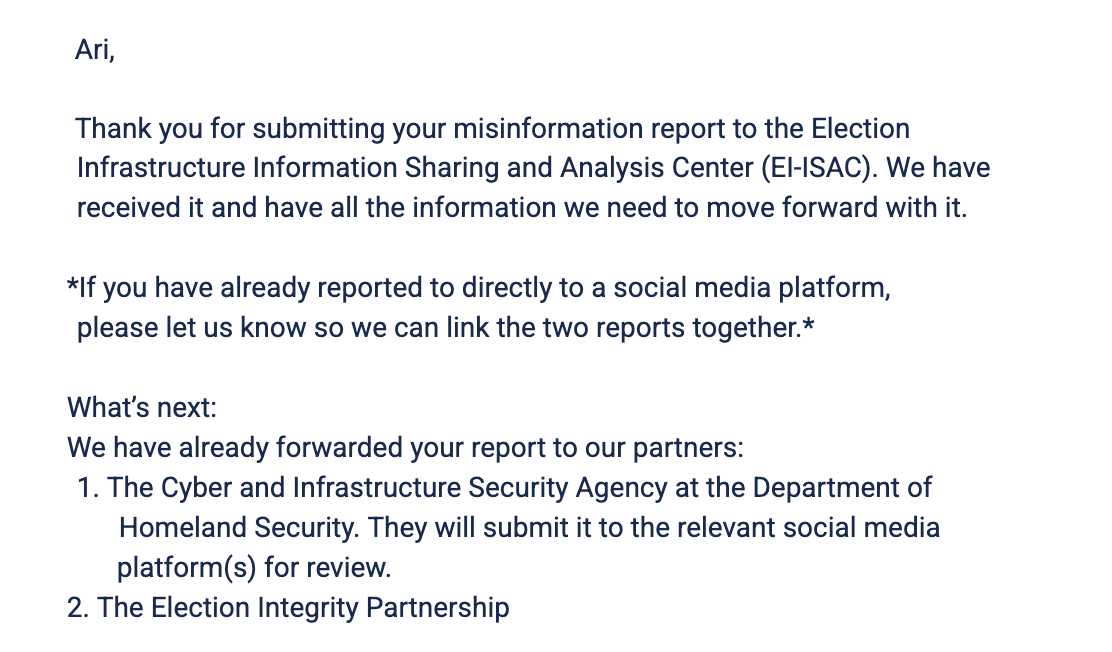
This was the first time an outsider had seen the plumbing of a wide-scale effort by federal agencies like the Cybersecurity and Infrastructure Security Agency (CISA) to regulate mis-, dis-, and malinformation in the social media landscape. It took considerable effort to untangle the mechanism by which complaints of “misinformation” were processed — the process was deliberately confusing — but the documents in the Twitter Files ended up playing a role in helping a landmark First Amendment case already launched in the courts, called Missouri v. Biden.
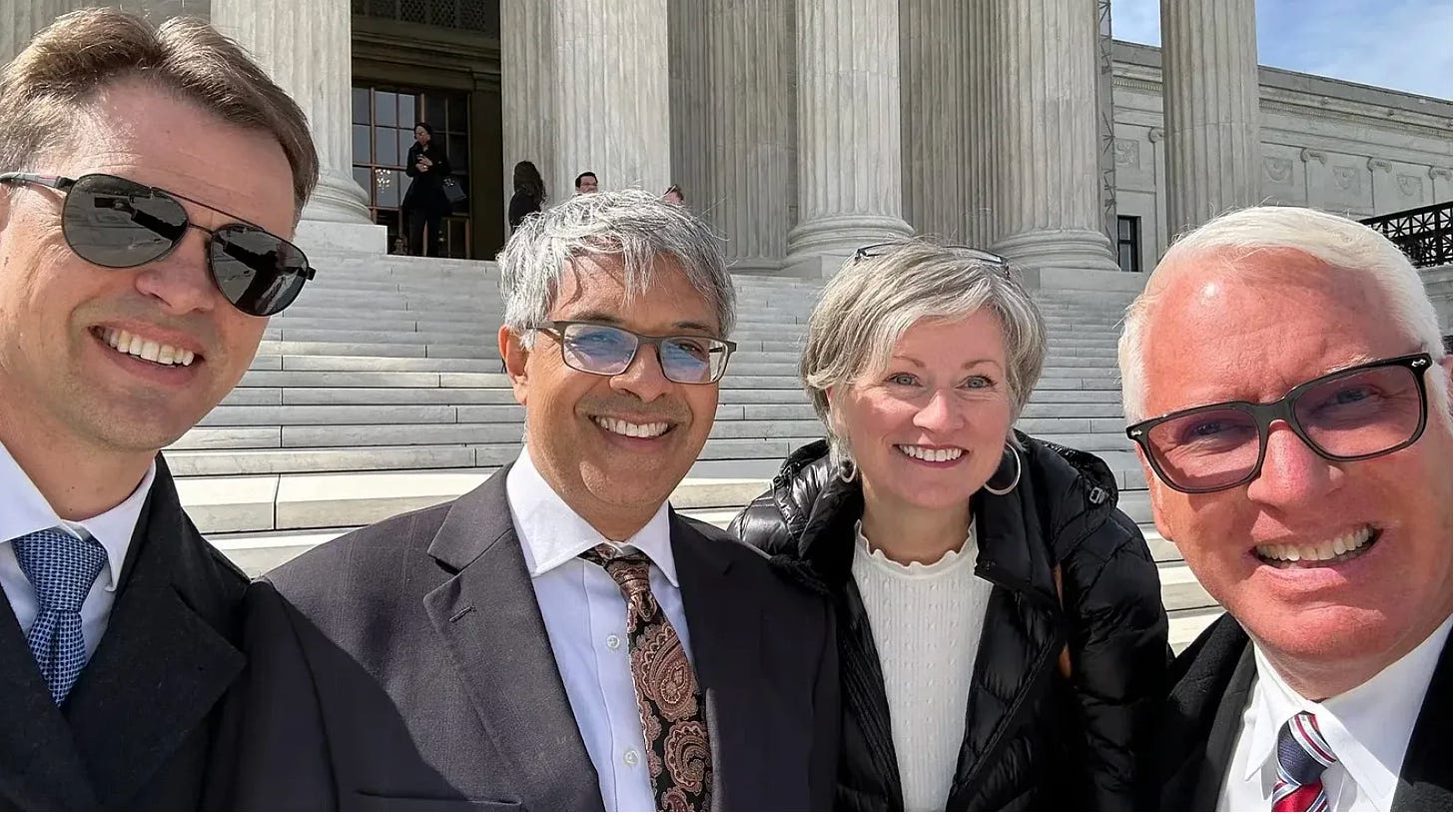
The general public, if it knows about this case at all, heard about the alleged “embarrassing defeat” plaintiffs like Dr. Aaron Kheriaty, future NIH Director Jay Bhattacharya, and Harvard’s Dr. Martin Kulldorff suffered in the Supreme Court in early 2024. This was often misreported, as the Supreme Court really punted on procedural issues and sent the case back down to be decided. It was forgotten until a consent decree was finally issued Tuesday, ending in victory for the plaintiffs. As Kheriaty wrote, the decree prohibits:
The U.S. Surgeon General, Centers for Disease Control and Prevention (CDC), and Cybersecurity and Infrastructure Security Agency (CISA) from threatening social media companies into removing or suppressing constitutionally protected speech on Facebook, Instagram, X (formerly Twitter), LinkedIn and YouTube.
“It was a victory, even if we did not get everything we wanted in the settlement,” said Kheriaty, the former professor of psychiatry at the University of California at Irvine, and chairman of the ethics committee at the California Department of State Hospitals.
Kheriaty, Bhattacharya, Hines, and others filed their first amended complaint on August 2, 2022 on the grounds that their social media posts about issues like Covid had been suppressed by a smorgasbord of government agencies, including the Department of Health and Human Services, the Centers for Disease Control and Prevention, and the Department of Homeland Security.
In that first complaint filed by the Missouri defendants, CISA was singled out based on evidence maladroitly conceded by Joe Biden’s own cabinet, as part of the argument for a controversial Disinformation Governance Board, which was to be headed by viral singing sensation Nina Jankowicz.
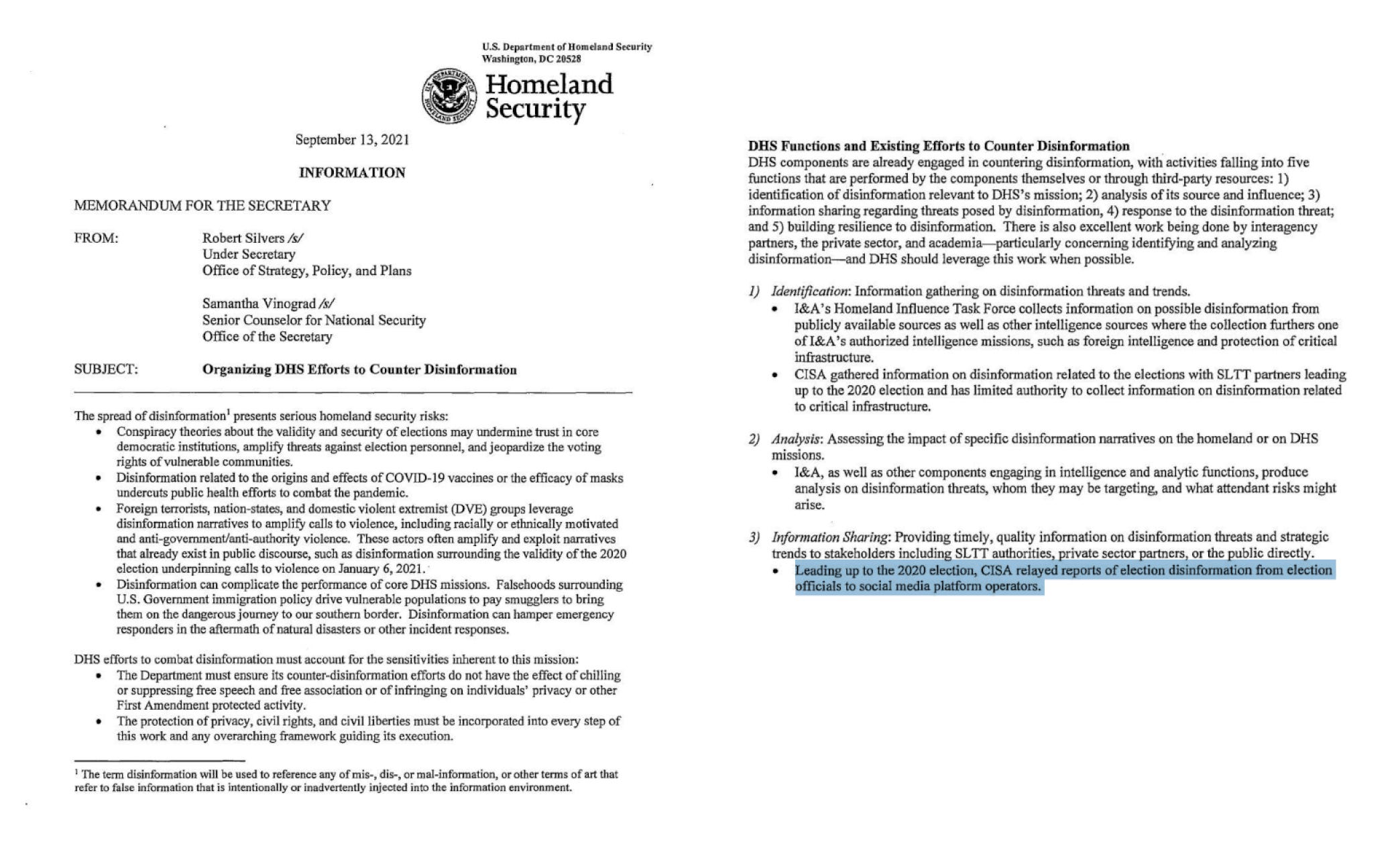
In a memo on September 13, 2021, DHS officials told then-Secretary Alejandro Mayorkas that “leading up to the 2020 election, CISA relayed reports of election disinformation from election officials to social media platform operators.” The Missouri plaintiffs didn’t know exactly what form this “relaying” took, but they correctly identified a serious problem: the government can’t pressure private carriers or publishers by labeling things “disinformation.”
This reflected a basic misunderstanding of the First Amendment, which was designed specifically to keep the state out of the Truth-Squadding business, particularly at moments like the Covid pandemic when the state might be seeking effective veto power over critical national issues.
The Consent Decree handed down this week put into the books concepts that should provide a little comfort to those of us who fought to surface this issue. One principle agreed upon is that “modern technology does not alter the government’s obligation to abide by the strictures of the First Amendment.” It also enjoined government agencies from threatening social media companies with “some sort of punishment” if they don’t “remove, delete, suppress, or reduce, including through altering their algorithms, posted social media content containing protected speech.”
Kheriaty talked about how he understood the accomplishments of Missouri v. Biden. His thoughts are similar to how I feel about the Twitter Files. The court case and the Twitter documents took a matter that was not only a non-issue in media (the existence of censorship programs was routinely denied before late 2022) and rapidly propelled it to the center of the American political discussion.
It reached the Supreme Court and, as Aaron pointed out, ended up being an issue that helped decide the 2024 election. In the Vice Presidential debate in 2022, when J.D. Vance was asked if his running mate was a threat to democracy, he responded that the widespread assault on the First Amendment was the threat he worried about:
In the intervening years, I’ve had to think about this a lot. I had to think about it last week. I had to think about it yesterday, and again today. Friends and colleagues regularly challenge the utility of a court case and scandal that allowed Trump and his own more-than-questionable approach to speech issues a chance to prevail in 2024, by capitalizing on Joe Biden’s idiotic government-wide jawboning program.
To this I ask, what was the alternative? Letting it go? A ruling permitting the behaviors detailed in Missouri v. Biden would have been far more devastating. If you’re concerned about a hyper-empowered chief executive intent on deamplifying, say, derogatory content about the war in Iran, you need it enshrined in law that threats and pressure to social media companies are strictly forbidden. In that regard, everyone irrespective of party should be happy about this result.
As for the 2024 election, Democrats had plenty of time to get on the right side of these issues. I know this because I privately pleaded with plenty of them behind the scenes to see how badly this was going to play in an election year. They not only refused to listen, but insisted on nominating two hardcore speech ignoramuses in Kamala Harris and Tim Walz, while smearing people like Kheriaty for bringing this case.
After the many controversies of the last few years, Democrats can probably be counted on to support the First Amendment for as long as Trump is in office, and you know what? That’s okay! That’s good. As long as both parties see the political benefit in appearing to be on the side of one of America’s core beliefs, it’s a win. It’s a testament to who really deserves the credit for decisions like this Decree: the public. Enough people expressed enough disgust about these behaviors that the First Amendment has been updated in the books, boasting a fresh coat of paint for the social media age. It’s good for everyone. When was the last time we could say that?
Congrats to Aaron and his co-plaintiffs, who went through a lot on the road to this result. Historians won’t know what a disgusting process it was to get here, but I’ll remember, and I hope Racket readers will as well. The plaintiffs who hung in deserve a hearty pat on the back. As John Vecchione, counsel for the New Civil Liberties Alliance put it, “Freedom of speech has been powerfully preserved by our clients.” It’s true, and a happy thing that a few people cared enough to see it through.
Great news Matt!! Thank you so much for carrying the water and keeping a light on this! Really happy for the plantiffs as well!
Cheers to all lovers of free speech!
Taibbi, you did so much, along with Michael Shellenberger and others - this is a win you influenced mightily.