


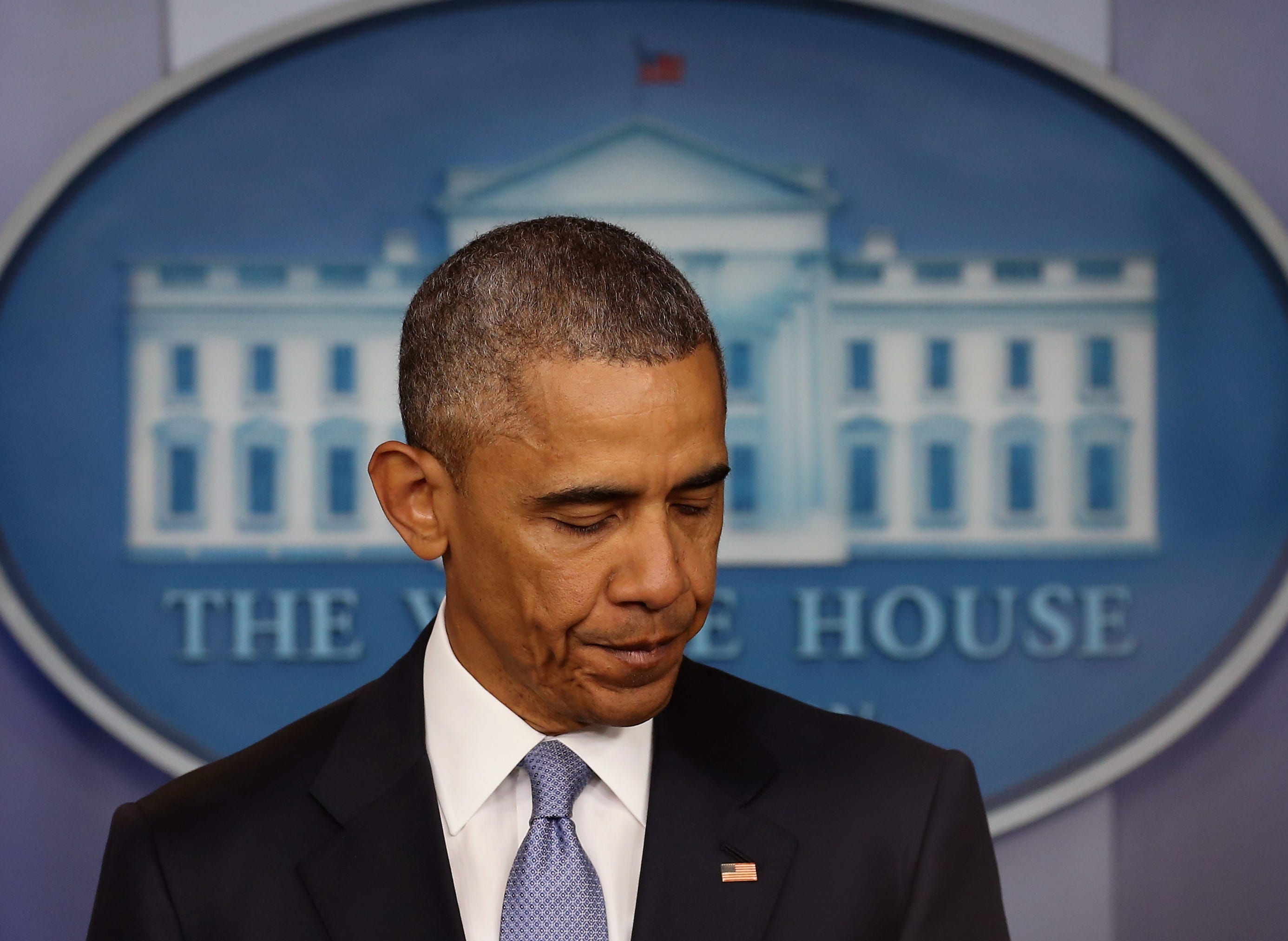
On February 6th, 2012, fourteen years before the current controversy over Venezuelan boat bombings, Scott Shane of the New York Times wrote a story with the ominous title, U.S. Said to Target Rescuers in Drone Strikes. Though the phenomenon had been mentioned in academic reports previously, the Times piece was one of the first press organs in America to describe “follow-up” drone strikes, which came to be better known as “double tap” strikes.
The piece explained that British and Pakistani journalists had counted 50 civilians had died in recent “follow-up strikes” that sources on the ground claimed were intended to kill rescuers and first responders. The Times report elicited a bizarre non-denial denial from Barack Obama’s White House, in which an unnamed spokesman said we should “wonder” about “misinformation” coming from “elements who would like nothing more than to malign these efforts and help Al Qaeda succeed.”
Because the U.S. and its allies were releasing so little information about these strikes, Amnesty International in 2013 sent a researcher named Mustafa Qadri to Pakistan to try to collect information about them. Currently the CEO and founder of a human rights organization called Equidem, Qadri conducted 60 interviews, mainly at nine strike sites in south Waziristan, Pakistan (the Pakistani government wouldn’t allow entrance into more heavily-bombed northern Waziristan). Qadri ended up compiling a long report that described the U.S. as complicit in a variety of grisly offenses. The first known strike took place in the village of Dhok in 2004, but after January, 2009, “President Barack Obama markedly expanded the use of drone aircraft for killings.”
Qadri put named sources to accounts of drone killings. This was rare, because there was significant fear of reprisal by Pakistani authorities at the time. He nonetheless detailed deaths of people like 68-year old Mamani Bibi, who was so accustomed to seeing drones that she continued work outside gathering okra at the sight of one on October 24th, 2012, until she was blown up in front of her grandchildren (who described the “terrible smell” and the site of her empty shoes) by at least two Hellfire missiles. Even more relevant to the present was Qadri’s documentation of a July 6, 2012 attack in the the village of Zowi Sidgi, where at least eight people were killed instantly in a first drone attack. When villagers rushed and found “body parts everywhere… bodies without heads and bodies without hands or legs,” people came with “stretchers, blankets, and water” until they heard a second missile coming and ran in all directions. At least eight more people were killed in this “second strike,” of which Qadri documented many. As he wrote:
How could the USA attempt to justify the second missile strike which appeared to target those who had gone to rescue people injured in the first strike and recover the dead? Attacking the injured and those who are hors de combat is prohibited under international humanitarian law; and medical personnel and first-responders trying to treat the wounded must be respected and protected.
The issue was looked at very differently back in the States. The video below is of Maine Independent Senator Angus King in February 7, 2013, roughly the same time as Qadri’s investigation, telling Donnie Deutsch and the rest of a Morning Joe panel that drone killings are “more civilized” in “the context of 1,000 years of war.” King’s only intellectual objection to drone strikes back then seemed to involve the possibility of American targets:
The dirty secret underlying the current mass freakout over “illegal orders” in Venezuela is that virtually every element of this story has reached the public before, only to receive very different reactions from people like King and the hosts of Morning Joe. The alleged “double tap” second strike on September 2nd seems to have been an outlier in the Venezuela campaign (at least, there haven’t been additional allegations along those lines yet). However, as Qadri noted then and now (see the Q&A below), the United States employed “double tap” strikes as a regular strategy in drone campaigns all over the world after 9/11.
Since last Friday’s still-disputed Washington Post report accusing the Trump administration of authorizing a second drone strike of shipwrecked drug suspects, politicians from both parties, retired military officials, and media figures have been rewriting history at a furious pace. One of the notable voices accusing the administration of “war crime”? Leon Panetta, who was Secretary of Defense during the period when the “Double Tap” strikes on Pakistan were taking place. This is Panetta this week:
Other comments raised eyebrows in different ways:
“American servicemen don’t kill noncombatants, they don’t torture prisoners, they don’t kill prisoners. That’s taught in Day 2 of basic training,” retired General Mark Kimmitt told CNN on Monday.
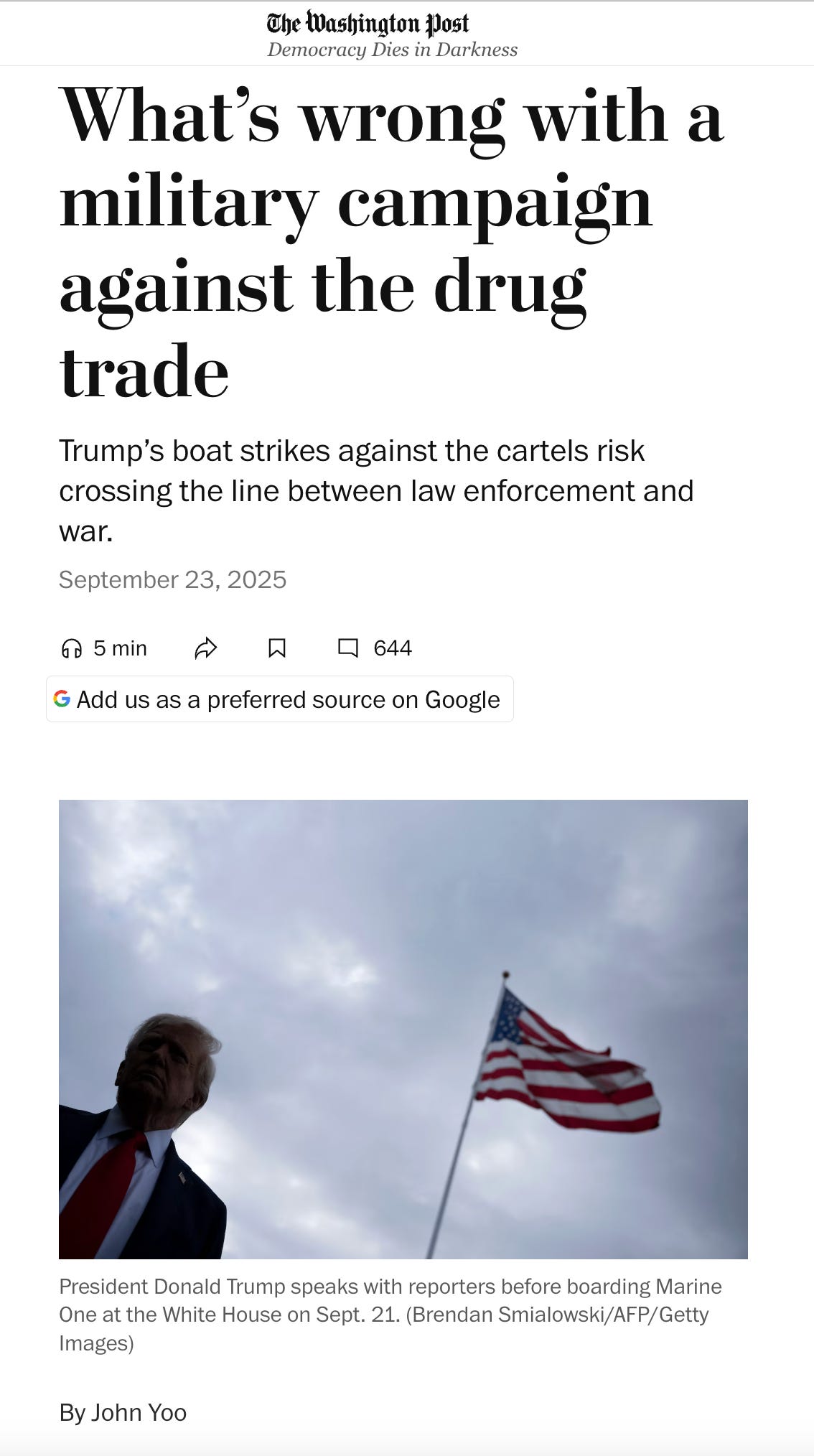
The network told of “unprecedented” military strikes that “sound like something from a Mafia hit” that are so appalling that even John Yoo — the lawyer who helped design the legal justification for George W. Bush’s “enhanced interrogation” policies against suspected terrorists — wrote an op-ed declaring “the U.S. cannot wage war against any source of harm,” adding “these attacks risk crossing the line between crime-fighting and war.”
The Trump/Hegseth scandal grew out of multiple different strains of recent American military history. One involves those prior “targeted killing” and bomb operations mainly across the Middle East that killed somewhere between 22,000 and 48,000 people from 9/11 through 2021 (a former CIA analyst who oversaw some of these operations put the number closer to 60,000). Another is in Barack Obama’s abortive Libyan campaign from 2011, which in some ways bore the closest resemblance to Trump’s Venezuelan mess.
That brief display of what one lawyer called “total lawlessness” was a ghastly bloodletting involving high-powered weapons and essentially defenseless targets, deployed for questionable if not outright fraudulent reasons by another White House acting unilaterally. Like Trump’s White House, Obama’s deputies concluded his campaign fell short of the definition of “hostilities,” among other things because “there are no troops on the ground” and “Libyans cannot meaningfully exchange fire with American forces.” This was one of the first post-9/11 instances in which the total absence of a compelling reason for military strikes forced a president to publicly retreat from a desired military campaign, but no one insisted on a policy change preventing future presidents from trying the same thing.
In America, most of this history has been forgotten. In the rest of the world, not so much. “Outside the western world, when Obama did it, there was outrage,” Qadri told us. “I think the difference [now] is there is less outrage outside the U.S. It’s become much more normalized.”
As noted in the accompanying “Insane Clown Pentagon” piece, the view that the Venezuela operations don’t rise to the level of an armed conflict isn’t exactly rare. You’ll find many legal voices this week denouncing the alleged second strike as not even a war crime, but just crime. Senator King was one of a number of politicians this week to embrace that idea. “That’s a stone-cold war crime. It’s also murder,” King said, seeming to have very different feelings about the level of civilization to drone strikes.
King could be right. The distinction in the Venezuela operations between law enforcement (when the state can use deadly force only as a last resort, in the face of imminent threat) and war or armed conflict (when states can use deadly force as a first resort, against a belligerent nation or group) has been blurred to the point of meaninglessness. The Trump White House has complicated things by not bothering to make a consistent case for why it should be allowed to fire on unarmed boats, and doesn’t seem worried, for instance, that former Philippine president Roderigo Duterte is facing an International Criminal Court charge for “neutralizing” drug dealers.
The history of this questionable double-droning strategy is extensive enough that we’re putting together a timeline with primary source documents and videos. Still, you won’t hear much about it this week, when shows like Morning Joe are exhibiting selective amnesia as they point out that, for instance, Japanese leaders were “executed” for similar decisions after World War II:
Racket’s Greg Collard reached out to Qadri, who gave the fascinating/surprising interview below about his experiences investigating double tap strikes and drone war, and his views on the relation of the past program to the present. He reminds us that robot war tends to make humans on the ground — any humans — more sympathetic:
Racket (Greg Collard): What are differences and similarities between the current operations and the 2012 U.S. drone strike in Zowi Sidgi, Pakistan?
Mustafa Qadri: The difference between then and today is how openly it’s being done. It’s really quite shocking. I still don’t think the people making these decisions realize the kind of precedent they’re setting because what applies to them could be applied by others.
The laws that prohibit these double-tap strikes are not moral codes. Attendees at the 1949 Geneva Conventions realized if you don’t put guardrails on conflict, there was a concern of us killing each other, that it would be the end of life as we know it. It’s absolutely about self preservation.

GC: Can you expand on that? What do you mean?
MQ: In modern society, the rules are already really permissive. If you’re a state with a military, there’s a lot of ground to kill people. They’re designed by powerful people. If someone isn’t a threat to you, you can’t kill them. You can capture them, you can even blow up a nearby vessel… These are really permissive laws of war they’re breaking. The only logical next step is the law of the jungle, and no one really wins out. When you have a party with a stronger force not following these rules, you force the weaker party to be unpredictable. You actually increase the risk of them committing terrorist acts or things you cannot expect rather than negotiate with you.
When you take these kinds of approaches, it seems like you’re being tough but it’s actually a very dangerous and reckless thing to do. The Taliban and Al-Qaeda that were being targeted were led by local people. In war zones, generally speaking, no one likes the combatants. They have a disregard for the local population. They steal their property, their food. Generally, the local population doesn’t like them.
Local populations saw drones initially as not as bad because there was less destruction, but the double-tap created such a terror that it really turned people away from the U.S. and its allies. They would have less fear and have more trust with local actors/combatants. They felt there was some way of connecting with them, as opposed to drones. which are so distant and terrifying, and so quiet. People get murdered before they don’t even realize they’ve been hit. So it really draws people away from the stated aims. It becomes a race to the bottom. You’re not as bad as the other person. In a lot of cultures and societies, you negotiate to survive. Venezuela is a really troubled society, but in the local day-to-day there is space for transaction. With drones, there is no one to negotiate with. It really shifts people’s attitudes.
GC: By turning people against you?
MQ: Right. Having interviewed combatants on the ground, I can see the attraction of not putting soldiers at risk, but not seeing the messy reality on the ground — war is a really brutal traumatic thing. There are times you have to go to war, but it’s always brutal. There are human consequences. You have to price that into your strategy. Drones sometimes can lead to less casualties, but the reality is it doesn’t dramatically change the equation. It’s a tactic. It’s not a strategy.
Since George Bush Jr. (and Barack Obama scaled it up), U.S. administrations have thought of drones as a strategy, but it’s more of a tactical weapon. It can’t take the place of a military strategy.
I don’t respect it. We documented really shocking killing from both Democratic and Republican administrations. When you look at the data we captured, it wasn’t that different than what these guys are doing in Venezuela. These strikes are more efficient, but they’re really being brazen about it. It’s like the mask is off.
Even with the Bush administration, there was a lot of concern about legality, a lot of talk and concern around torture. I think that when you’re a powerful interest like the U.S., the rules are important. There was eventually a realization [in the Bush Administration] that the law is important. Now, there’s a total disregard for the law.
GC: What in your experience is the consequence of that disregard?
MQ: You can go to places where there is no concept or respect for the law, and the levels of brutality are off the scale. When you go to war and there’s no monitoring, things can spiral rapidly. It’s an unnatural environment. When you are this brazen about the law, it’s really dangerous.
My personal opinion is that it’s very clear double taps are an act of terrorism. The U.S. military is not the first to do a double tap. It’s been done for many years. The only reason they are doing it is they are trying to convey a sense of terror.
Greg: Why? Is there an upside to conveying a sense of terror?
MQ: It psychologically breaks people. The thinking is you can defeat them in a different way. The sad thing is, it’s effective. But there is another side, and that’s that there’s more than one bad guy out there. There are bound to be people in the Venezuelan military that say we want to get these guys back, and terrorize them. You could say [the boat] was a military objective, but from my experience, it was really clear they were targeting the rescuers and I don’t see any military objective in that.
GC: Do you think there is more outrage now because Trump is the president? Do you think there was similar outrage at President Obama?
MQ: Outside the western world, when Obama did it, there was outrage. I think the difference [now] is there is less outrage outside the U.S. It’s become much more normalized. Governments are getting more autocratic anyway. People are more divided. There’s a sense that there is a good population and a bad population, and if the bad population gets it, that serves them right. That’s a growing phenomenon now.
It’s really hard for a lot of liberal commentators to appreciate this. Trump is seen as a tough guy by a lot of non-western audiences. When he acts beyond the law, it is affirming for a lot of people that this is the way you deal with terrorists and your enemies. Many see Trump as out of control, but the U.S. is still seen as the main global power, so the actions of the Trump administration are still very influential. I don’t think the western audiences realize it’s norm-setting. It sends the message that everyone can do this.
What Trump is doing is expanding on something that already existed. That’s something important for people to realize. As an international lawyer, I’m a huge fan of the role the U.S. played in setting up the international legal system. The Americans were the ones who insisted people go to trial. That system is being systematically dismantled, and it’s really a worrying development.
This is simply the end of "rules for thee, but not for me" governance, Dems have foisted on Americans. It never occurred to Dems cheering Obama droning hundreds of citizens of nations, on which the US had never declared war, a subsequent Rep President might do the same? Including utilizing a 2nd shot, to ensure the job was done.
Obama single handedly declared people terrorists, and then blew them off the face of the earth, including the occasional American citizen and or collateral child. He was Judge, jury and executioner. Dems lined up for miles to defend him. Now Trump is simply following the Obama playbook, and suddenly the policy is a "war crime and murder"?
Do Dems not realize there exists this thing called video, and it vividly shows them defending Obama, everyday of the week and twice on Sundays?
As this article and the interviewee makes clear - "The difference between then and today is how openly it’s being done."
Meaning, the only reason we're even having this conversation is that Trump isn't killing grandmothers in secret like Obama and lying about it, along with two-faced scum like Angus King. These are narco-terrorists Trump is killing. Openly. You want to give THEM your sympathy? How about the parents of the dead, thanks to the products these criminals bring in.
Oh, and Matt, when you do your timeline, make sure you don't forget Fast and Furious, where Eric Holder, Obama's AG used American taxpayer money to send arms to these same cartels. Don't forget that, okay?