

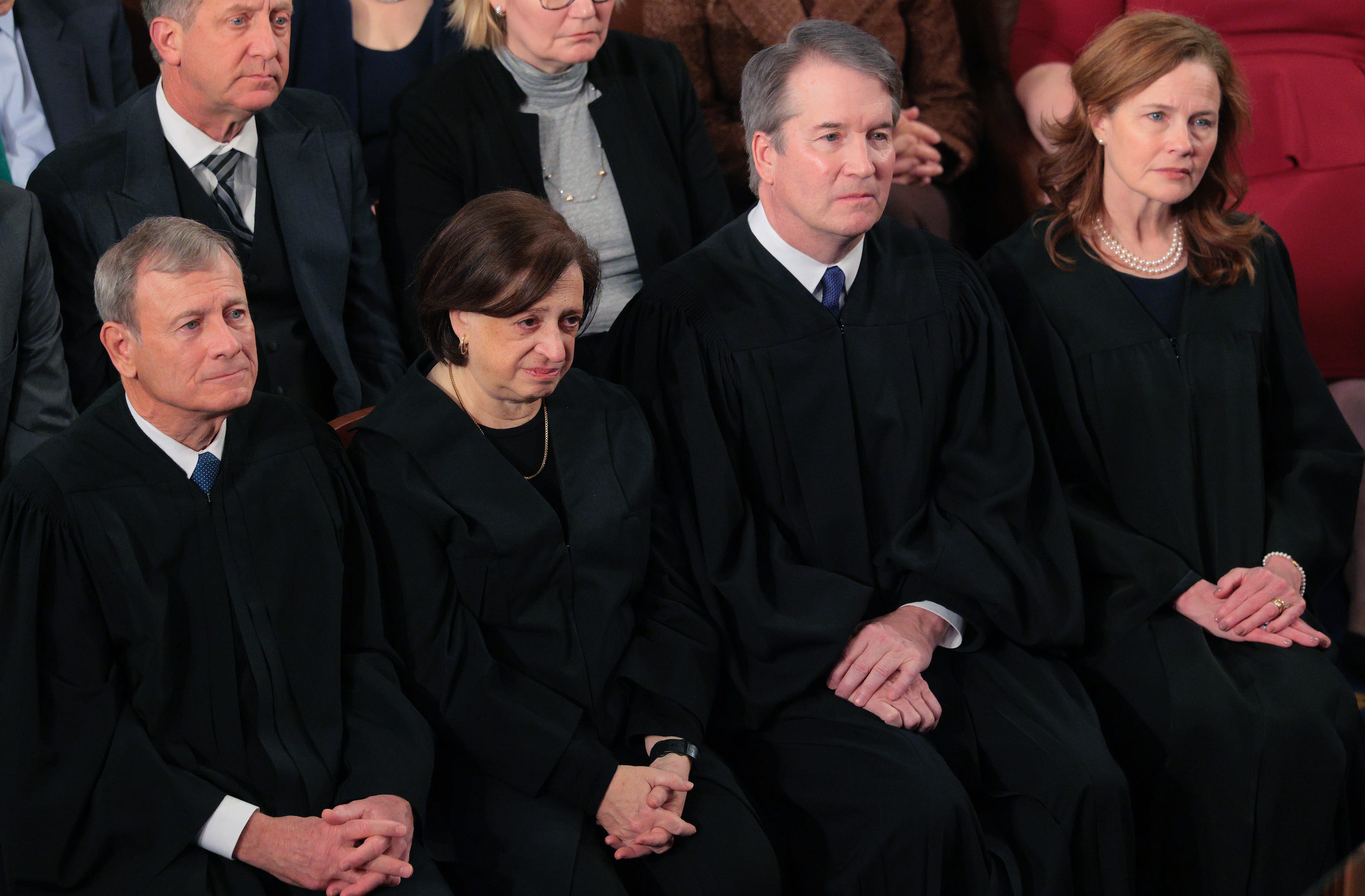
From Mother Jones yesterday:
The science is far from settled about whether trans girls who have received gender-affirming treatment actually have a competitive advantage or pose a greater risk of injuring other players. But the majority opinion, by Justice Brett Kavanaugh, glosses over those unknowns—reasoning that “biological sex” is a good enough proxy for athletic ability for states to categorically ban trans girls from girls’ sports.
It was once uncontroversial to observe that testosterone gives athletes advantages. Baseball’s steroid scandals were only a tick of the historical clock ago, and the number of people in the continental United States willing to stand up and say Mark McGwire and Raffy Palmeiro hit their own homers would have fit in a dentist’s waiting room. Every working comedian in the country made at least one joke about balloon-headed liar Barry Bonds:
This was universal, but once the trans issue with its myriad lifestyle and political considerations came along, the general public was suddenly asked to accept one factual absurdity after another about the same thing. “Far from settled!” Really, Mother Jones?
The Supreme Court Tuesday handed down a landmark 6-3 ruling in West Virginia v. BPJ and Little v. Hecox, upholding two state bans on the participation of transgender athletes on women’s and girls’ sports teams. Justice Brett Kavanaugh, who wrote the majority opinion, used strong language in upholding West Virginia and Idaho statutes, saying the court disagreed that “schools must allow biological males… to compete on girls’ sports teams.” Kavanaugh even used a hated term, asking, “May schools determine eligibility for women’s and girls’ sports based on biological sex? The answer is yes,” upsetting pundits who want officials to stick to activist-approved phrases like “sex assigned at birth.”
“It’s a good decision for women and girls,” said Kara Dansky, who wrote an amicus brief supporting the states for the U.S. chapter of the Women’s Declaration International.
Dansky was once senior counsel for the ACLU Center of Justice. In this case she was on the other side of the ACLU, whose attorneys (including co-director of LGBTQ and HIV rights, Chase Strangio) argued against the state bans. The ACLU has also split with former feminist allies by arguing for the housing of biological men in women’s prisons, including those with records of violent sex offenses. These efforts in trying to force society to reimagine biology are clearly failing, but the outraged reaction yesterday shows the fight isn’t over. NBC described the decision as a “major blow to LGBTQ rights,” and former VP contender Tim Walz claimed the “Supreme Court says schools can be cruel to trans kids”:
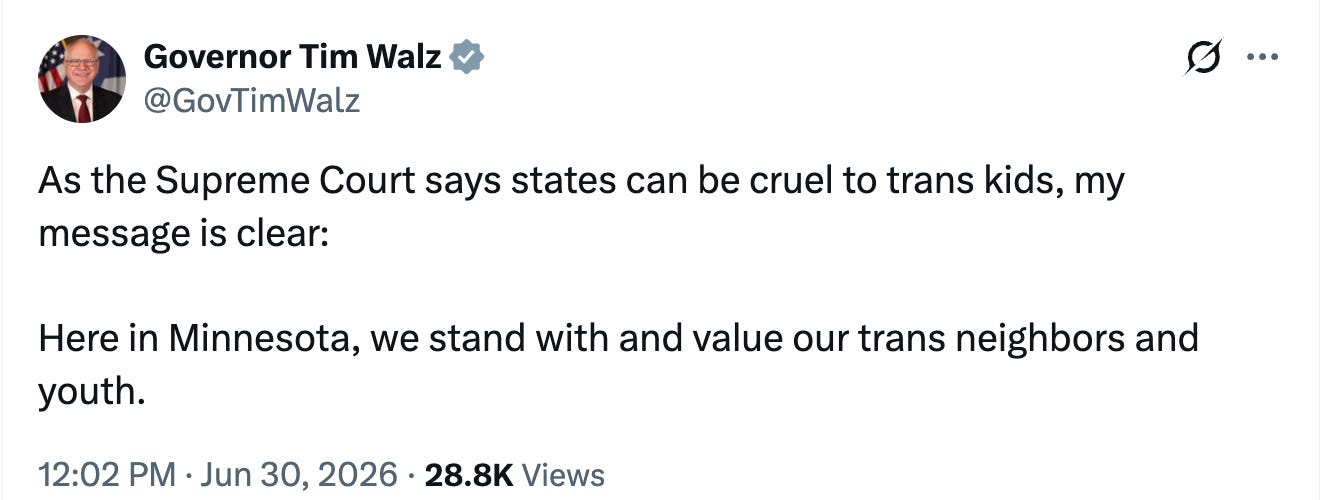
Cruel is an extraordinary word to describe the act of allowing states to object to a radical social program that was implemented virtually everywhere ahead of both scientific and (especially) political consensus. The numbers aren’t close. A New York Times/Ipsos poll last year found 79% of Americans, including 67% of Democrats, are opposed to “athletes who were male at birth” participating in women’s sports. The same poll found 71% of all Americans, including 54% of Democrats, believe no one under 18 should have access to puberty blockers. This was after exposure to years of movement messaging.
Strangio and the ACLU don’t see that they’re asking for something people can’t give them, even if they wanted to, namely the honest belief that people who’ve transitioned have literally changed sexes. The gambit failed for the same reason Spanish speakers rejected “Latinx.”
Like politics, language has a democratic dynamic. If people don’t use Latinx because Spanish (like 38% of all languages) is a gendered tongue with its own distinct sonic system that Spanish speakers love, they won’t use it, and you can’t make them. The ostensible logic behind Latinx was to “challenge the gender binary” and “remove gender from Spanish,” in part because a handful of intellectuals claim gendered language causes unequal economic outcomes. A rational person finds this absurd, unless you believe the early French schemed to consign bananas to girlhood while making boys out of tuna as a weirdly subtle means of oppressing women in future centuries.
As with Latinx, activists tried to lobby “sex assigned at birth” into reality, only to have the population spit it back out as “biological sex.” The court just recognized another thing that was uncontroversial until ten minutes ago. Yes, a small percentage of human beings have intersex characterstics, but most of the world’s population can’t be forced to unlearn what it intrinsically knows. Knowing which gametes your body cranks out is another form of “lived experience,” one is irrelevant to activists, apparently, because it’s “normative.” People know they weren’t “assigned” a sex by hospital clerks. Some people tried to think that way. It just didn’t take.
Activists could have started with a proposition: given that sex is binary, what can society do to accomodate people who experience dysphoria and wish to live under a new identity? The same Americans who accepted gay marriage fairly quickly after Obergefell v. Hodges 11 years ago likely would have extended as far as they could without jumping into a factual or scientific abyss, on issues ranging from expanded insurance to easier routes to housing or identification. Instead, activists treated access for biological males to women’s locker rooms, sports rosters, even prisons as settled rights matters, against which only right-wing Christian patriarchal bigots could possibly object. Unless 80% of Americans are bigots, a lot of apologies are owed:
